
Custom SMT nozzle and gripper
Custom Nozzle & Gripper for Smart EMS PCB Assembly
Southern Machinery designs and machines custom SMT nozzles and gripper nozzles for odd-form parts. JUKI, Yamaha, Fuji, Samsung, Panasonic. Send a component for a quote.
A mounter can only place what its tooling can hold. We design, machine and test the nozzle or the gripper that lets your line place the odd-form parts it currently sends to a manual bench.
Key features
Suction stops working at the edge of the envelope
A part with an uneven top face cannot form the seal suction needs. A part that is too heavy slips under acceleration. A part with a fragile face is marked by a rigid tip. Those three failures account for most of the odd-form work still sitting on a manual bench.
The tool has to match the component, not the machine
A gripper is designed around the external profile of one part family. That is why the same head places a 0402 chip and then needs a different tool for a 9.5 mm bobbin. The machine is rarely the constraint; the interface to the part is.
The cost of not solving it never appears on the BOM
Manual odd-form placement is not a line item. It is an operator, a bench, a rework step and a first-pass yield that never quite reaches the target. The calculator below is built so that you can put your own numbers into it.
Specifications
Figures as published in Southern Machinery documents. Where two sources disagree, both values are shown with their source.
| Gripper nozzle 2071, jaws closed | 8.5 · mm · CAD sheet · Verified material |
|---|---|
| Gripper nozzle 2071, jaws open | 18.5 · mm · CAD sheet · Verified material |
| Gripper arm width | 7 · mm · CAD sheet · Verified material |
| Gripper arm height | 7 · mm · CAD sheet · Verified material |
| Component size, gripper 2071 | 9.5 - 17.5 · mm · CAD sheet · Verified material |
| Gripping range, gripper nozzles | 0.8 - 5.2 · mm · Juki nozzle catalogue note · To be confirmed |
| Pickup rate | 99.99 · % · Nozzle sheet · Verified material |
| Custom build lead time | 1 · week · Nozzle sheet · To be confirmed |
| Custom build lead time | 2 - 4 · weeks · Design note · To be confirmed |
| Support window | 7 x 24 · hours · Nozzle sheet · Verified material |
| Standard nozzle body material | Copper alloy · - · Juki standard nozzle note · To be confirmed |
| Tool material for wear | Tungsten steel · - · Design note · Verified material |
| Tool material for static | Ceramic · - · Design note · Verified material |
| Tool material, wear and static | Diamond steel · - · Design note · Verified material |
| Soft tip material | Rubber or silicone · - · Design note · Verified material |
| Component sample wanted for a quote | 4 - 6 · inches of tape · Design note · Verified material |
| Vacuum, general placement | at least 400 · mmHg · Design note · Verified material |
| Vacuum, large components | at least 70 · mmHg · Design note · Verified material |
| Placement force, odd-form head | up to 100 · N · Industry reference · Verified material |
| Component weight, odd-form head | up to 300 · g · Industry reference · Verified material |
| Component footprint, odd-form head | up to 200 x 125 · mm · Industry reference · Verified material |
| Adaptive head, height levels | 1 - 25 · mm · Industry reference · Verified material |
| Placement accuracy, standard vacuum | within 0.02 · mm · Industry reference · Verified material |
| Nozzle service life | several · months · Design note · To be confirmed |
| Nozzle service life | more than 24 · months · Design note · To be confirmed |
| Dirt removed by a nozzle cleaning machine | 99 · % · Design note · Verified material |
Models, comparisons and open points
Where our own documents disagree, printed side by side (6 rows)
| Parameter | Source A | Source B | Source C | Status |
|---|---|---|---|---|
| Custom build lead time | 1 week (nozzle sheet) | 2 - 4 weeks (design note) | about 1 month (custom solution sheet) | To be confirmed |
| Gripping range, gripper nozzle | 0.8 - 5.2 mm (Juki nozzle catalogue note) | 9.5 - 17.5 mm (2071 CAD sheet) | not stated | To be confirmed |
| Standard nozzle body material | copper alloy (Juki standard nozzle note) | tungsten steel, ceramic or diamond steel (design note) | not stated | To be confirmed |
| Custom nozzle part code | CN-SM-2713 (catalogue board) | Nozzle 2071 (CAD sheet) | JUKI-nozzle-customized (image library) | To be confirmed |
| Nozzle service life | several months (design note) | more than 24 months (same design note) | not stated | To be confirmed |
| Component sample wanted for a quote | 4 - 6 inches of tape (design note) | drawings accepted (catalogue entry) | not stated | To be confirmed |
Which tool handles which component family (8 rows)
| Component family | Handling method | Published envelope | Note |
|---|---|---|---|
| Chip components, 0201 to 1206 | Vacuum nozzle | standard range | the default case, and the one standard nozzles are built for |
| MELF and cylindrical parts | V-groove nozzle | standard range | the groove keeps a round body from rolling on the tip |
| Electrolytic capacitors and bobbins | Gripper nozzle | 9.5 - 17.5 mm on the 2071 tool | the tool grips the body, not the top face |
| Terminals, pins and eyelets | Gripper or slot nozzle | not published | a slot enters between the parts of a connector block |
| Board-to-board and ribbon connectors | Slot nozzle | not published | narrow rectangular cross-section |
| Large ICs, sockets and shields | Pipe nozzle | not published | a wide suction area with an interchangeable rubber tip |
| Heavy or uneven parts | Friction gripper jaws | up to 300 g on an odd-form head | the jaw takes the load, so the vacuum seal is no longer critical |
| Parts needing axial force, such as pin-in-paste | Friction gripper jaws | up to 100 N on an odd-form head | the head applies the force; the tool holds the alignment |
In detail
From a component sample to a validated tool, in nine steps
Every step below produces something you can look at. Nothing is quoted from a written description alone.
- Receive the component. Send the part itself, ideally four to six inches of tape or a tube, or a drawing with the critical dimensions called out.
- Measure what matters. Outside profile, the face the tool has to bear on, mass, centre of gravity and any lead or pin pattern.
- Choose the handling method. Vacuum, friction jaws, a hybrid of the two, or a slot. The method follows the part, not the machine.
- Model the jaw. CAD geometry with the chamfers and radii that let the part enter the jaws without being pushed off centre.
- Check the structure. Thicker sections where the jaw sees the bending load during acceleration, so the head does not have to compensate for a flexible tool in software.
- Machine and fit. Body and jaw are cut to the interface your head expects, so the tool seats and repeats at the same height every cycle.
- Test on your component. Pick and place cycles on your own part, at production speed, with the pickup rate recorded and shipped with the tool.
- Validate the material. Tungsten steel, ceramic, diamond steel or a soft tip, chosen against wear, static and how fragile the component is.
Three families of custom tool, and the parts each one is built for
These three cover most of what an EMS quote asks for. The photograph library further down carries the rest.
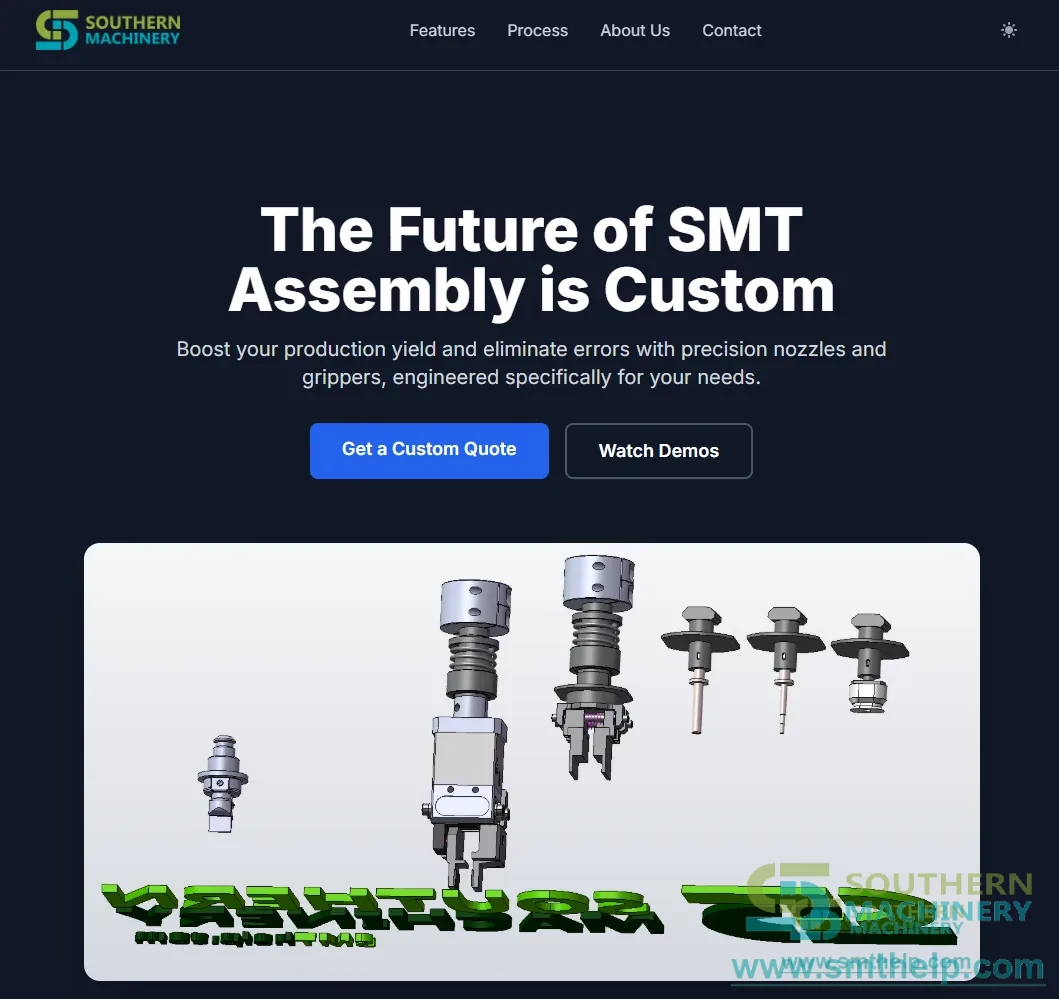
- Custom gripper nozzles on a machined body. Three gripper nozzle bodies photographed on the bench, each showing the two-prong jaw that closes on the component.
- 500-series vacuum nozzles. Two 500-series nozzles: the green cap, the spring that keeps the tip compliant, and the machined aluminium body that seats in the head.
- JUKI gripper nozzle, 2071. The tool that supplies this page with its numbers: arm width and height 7 mm, jaws closed at 8.5 mm, open at 18.5 mm, for components from 9.5 mm to 17.5 mm.
Where our own documents disagree, printed side by side
These are the places where two sources we hold give different figures. We have not averaged them and we have not picked one. Ask us for the current drawing for your configuration before you order.
Which tool handles which component family
A quick map from the part in front of you to the tool that picks it. Where a figure is published it is printed; where it is not, the row says so.
What can be changed on a custom tool
Each of these is a decision you can make before the drawing is released.
- Handling method. Vacuum, friction jaws, hybrid suction plus jaws, or a slot, chosen from the shape of the part.
- Tip and jaw material. Tungsten steel, ceramic, diamond steel, or a rubber and silicone tip for delicate faces.
- Body length and interface. Cut to the interface your head expects, so it seats without an adapter.
- Coatings and surface finish. A coating to stop sticky or soft parts adhering to the tip.
- Error-proofing. Asymmetric keying on jaws that look alike, so a tool cannot be fitted the wrong way round.
- Marking and identification. The part code engraved on the body, so a tool on a bench can be identified without measuring it.
What happens after the tool lands
Six steps, and the first one is the only one that normally causes trouble.
- Fit and check the seating height. Seat the tool, then check the tip height against the head datum before running a cycle.
- Teach the pickup position. Set the pickup point in the machine's component data, then verify it with the head camera.
- Set the placement force. Start low for a fragile part and raise it until the placement repeats, not until it seats once.
- Run the pickup-rate test. Fifty cycles at production speed, with the misses counted, before the tool goes into the program.
- Write the inspection interval. Decide how often the tip is checked, and put it in the maintenance schedule rather than reacting to a fault.
- Keep the spare. A second tool on the shelf converts a tool failure from a line stop into a changeover.
What you get after the tool ships
Four things, and none of them are conditional on a service contract.
Videos
Clips from the Southern Machinery YouTube channel. Nothing loads from YouTube until you press play.
Catalogues and documents
- PDFSouthern Machinery Customized Feeder Nozzle Catalog V03Custom nozzle and gripper catalogue
- PDFYamaha - Nozzle Catalogue -By SMThelpCustom nozzle and gripper catalogue
- PDFSMT Nozzle Supplier -Southern MachineryNozzle supplier sheet
- PDFSMT JUKI Serial Nozzle w 3D samples--Southern MachineryJUKI serial nozzle sheet
- PDFSMT JUKI Serial Nozzle--Southern MachineryJUKI serial nozzle sheet
- 3DJUKI Customized Nozzle CN-SM-2713Drawing library
- 3DSMT customized nozzle design n manufacturingDrawing library
- 3DSMT Gripper nozzle customizedDrawing library
- PDFSMT Gripper nozzle customized 3DDrawing library
- PDFSMT Gripper nozzle for E-cap 3DDrawing library
- PDFSMT JUKI Gripper Nozzle Terminal 0.8mm 3DDrawing library
- PDFJUKI Nozzle 505 3DDrawing library
- PDFSMT JUKI Vacuum nozzle CN2617-03 3DDrawing library
- 3DVideo board - every Southern Machinery clip
- 3DCatalogue board - every document
- LINKMachine catalogue - file.autoinsertion.com
Engineering notes
ARTICLE 01The Odd-Form Part Your Mounter Refuses to Place Is a Tooling Problem, Not a Machine Problem
When a placement head rejects a component, the reflex is to blame the machine or the component. Almost always it is the interface between them, and that interface is a part you can order. Full articles are in English. The summary above carries the argument in your language. A mounter that refuses a component is not…
ARTICLE 02Why Your Best Operator Is Still Feeding Connectors by Hand
The bench exists because the parts on it are the ones nobody designed a tool for. That is a procurement gap, and it is closable. Full articles are in English. The summary above carries the argument in your language. Walk onto most EMS floors and there is a bench with connectors on it, and a person putting them on…
ARTICLE 03How to Tell Whether an Odd-Form Component Can Be Placed Automatically
Six questions about the part itself that predict, before anyone quotes anything, whether a tool can pick it reliably. Full articles are in English. The summary above carries the argument in your language. There is a version of this conversation that wastes months: a part goes back and forth between a factory and a…
ARTICLE 04Six Measurements to Take Before You Ask for a Custom Nozzle Quote
The measurements that decide the design, and the order to take them in. Arriving with these turns a two-week exchange into a single message. Full articles are in English. The summary above carries the argument in your language. The single most common reason a custom nozzle quote takes two weeks is that it is missing…
ARTICLE 05What a Nozzle Actually Costs Over a Year, Not at the Counter
The purchase price is the smallest number in the calculation. Wear, pickup rate, downtime and the labour behind the bench are the ones that move. Full articles are in English. The summary above carries the argument in your language. A nozzle is one of the cheapest things on a placement line and one of the few that…
ARTICLE 06Designing a Gripper Jaw Around a Component You Have Never Seen Before
What a drawing can and cannot tell a tool designer, and why a sample in the post is worth more than a dimensioned PDF. Full articles are in English. The summary above carries the argument in your language. A drawing tells a tool designer the shape of a part and almost nothing about how it behaves. The gap between…
Frequently asked questions
What do you need from me to quote a custom nozzle?
The component itself, ideally four to six inches of tape or a tube, or a drawing with the outside profile and the face the tool bears on dimensioned. Photographs help but cannot replace a measurement.
Which machine brands can you build for?
Our nozzle line covers Yamaha, Fuji, JUKI, Samsung, Panasonic, Hitachi, I-pulse, Siemens and ASM, Universal, Mirae, Sanyo and Sony. If your head is not on that list, send the interface drawing and we will say whether we can cut it.
Can you place a part that is too heavy for vacuum?
Yes, with friction jaws. An odd-form head in this class applies up to 100 N of placement force and carries components up to 300 g, so the jaw takes the load and the vacuum seal stops being critical.
How long does a custom tool take?
Our own sheets disagree: the nozzle sheet publishes one week, and the design note says two to four weeks with about a month for a fully customised solution. Treat two to four weeks as the planning figure and ask us to confirm against the drawing for your part.
What material should the tool be made from?
Tungsten steel for wear, ceramic for static-sensitive parts, diamond steel when you need both and can accept the cost, and a rubber or silicone tip when the part face marks easily. Ceramic is fragile, so budget for spares if you choose it.
Will a custom tool void my machine warranty?
That depends on your machine supplier, not on us, and we will not guess. The tools are cut to the standard interface your head expects and need no machine modification, which is the usual condition, but confirm it with your supplier.
How do I know the tool works before it ships?
It is run on your own component at production speed, and the pickup rate from that test ships with the tool. You are not accepting an untested part.
Can I reorder the same tool later?
Yes, against the drawing you validated, so a second tool behaves like the first. Ask for the drawing number to be quoted on your purchase order.
Related products
JUKI SMT Pickup Nozzle
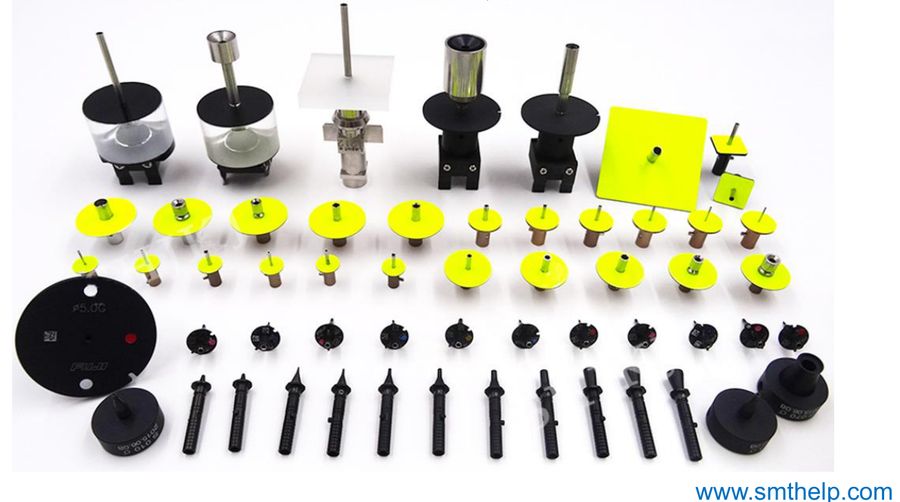
Vacuum, slot, gripper and pipe pickup nozzles for JUKI KE-2010 to KE-2060, FX-1 and 700 series mounters. Tip bores from 0.4 mm to 9.5 mm, copper-alloy body, custom design, one-week lead time.
FUJI-compatible SMT Pick-and-Place Nozzle
Southern Machinery designs and manufactures FUJI-compatible SMT pick-and-place nozzles — NXT H01/H04/H04S/H08/H12/H08M/H24, CP/QP/IP and custom LED tips from ø0.3 to ø15 mm, ceramic, metal and rubber-pad, with OEM data-matrix and colour-matrix codes. Dimensional drop-in fit, one-day spare-parts lead time, five-day custom design. Request a nozzle match.

SMT Customized Nozzles & Grippers for PCB Assembly
Southern Machinery designs and manufactures custom SMT nozzles and gripper nozzles for smart EMS PCB assembly. 99.99% pickup rate, diamond steel and ceramic tips, Plug & Play for JUKI, Yamaha, FUJI, Panasonic. 2-4 week delivery, 50+ countries.
SMT Pickup Nozzle (multi-brand series)
Pickup nozzles for JUKI, Yamaha, Siemens/ASM, FUJI, Panasonic and Samsung/Hanhwa mounters: vacuum, slot, gripper and pipe types, standard and custom design, matched to your head. One supplier for the whole nozzle shelf.
Panasonic-compatible SMT Pick-and-Place Nozzle
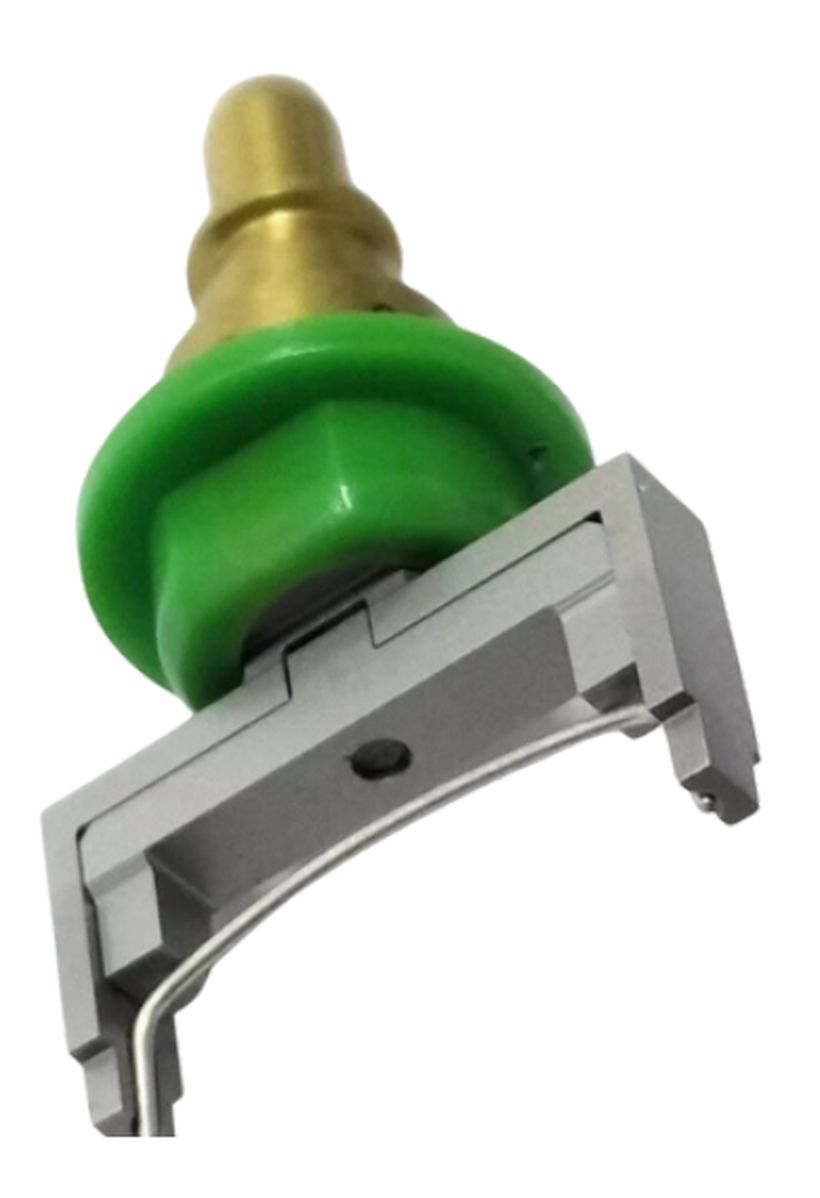
Southern Machinery designs and manufactures Panasonic-compatible SMT pick-and-place nozzles for NPM (D3/W/TT2/VF) and CM (402/602/603) mounters — vacuum, gripper, calibration and custom odd-form tips from 0402 to Φ10 mm, ceramic, metal and rubber. N6100xxxxx part numbers reproduced, dimensional drop-in fit, one-day spare-parts lead time, five-day custom design. Request a nozzle match.

Siemens / ASM SIPLACE Pickup Nozzles (7xx, 9xx, ceramic families and custom)
Siemens and ASM SIPLACE pickup nozzles, matched to your 12-star head, C&P20A star or CPP segments. 128 documented 7xx/9xx datasheets, ceramic and custom tips, vacuum-tested. Identify, verify, replicate.
Request a quote for Custom SMT nozzle and gripper
Send your board, component list or machine model and we reply with a configuration and quotation. Prices are quoted per project.