
S3000 Radial Insertion Machine
Radial components inserted at up to 20,000 an hour without building a line around them
S3000 radial insertion machine for THT PCB assembly: taped radial components inserted at up to 20,000 CPH, 0-360 degree insertion angle, 10 feeder stations and machine-vision hole correction.
The S3000 is a radial taped-component inserter built for Smart EMS factories. Ten feeder stations as standard, fourteen if the product mix needs them. Insertion at any angle from 0 to 360 degrees in one-degree steps, machine-vision hole correction, and a wear-parts list that crosses to Universal. Boards from 50 x 50 mm to 400 x 300 mm, from 0.79 mm to 2.36 mm thick.
- 20,000
- CPH top speed, specification sheet
- 0-360°
- Insertion angle, 1° steps
- 10
- Feeder stations, 14 optional
- 0.7 mm
- Maximum component lead diameter
Key features
Half the capital, on the vendor's own sheet
Southern Machinery's specification sheet states the machine requires only 50% of the investment compared with competitors. Treat that as a vendor claim and test it against the two quotations in front of you - but it is the reason this machine exists in the range at all.
Payback inside one budget year
The same sheet claims a quick return of less than one year. The calculator further down this page is deliberately built so you can check that claim with your own component count, board volume and wage, instead of accepting ours.
Wear parts that cross to Universal
The brochure states 100% compatibility with Universal machine wear and tear spare parts. On a machine that runs every day, the spare-parts catalogue is a larger long-run cost than the purchase order, and it is the line item buyers forget to compare.
Monthly usage cost under $100
A stated monthly usage cost below $100 is what decides whether a second machine is affordable. It is also the number that makes small and medium volume work economic, which is where most radial insertion decisions actually live.
Eight servo axes on bus control
The user manual describes eight servo sets driven over bus control with absolute encoders, which it says removes a large number of photoelectric sensors and the wiring that goes with them. Fewer sensors means fewer things to fail and a shorter fault-finding path when something does.
Built for boards that change every week
The applications the manual names are power supply boards, home appliance controller boards, air-conditioner boards and audio control boards. Mixed product, changing component counts and frequent changeover are the normal case for the factories this machine is aimed at.
Specifications
Figures as published in Southern Machinery documents. Where two sources disagree, both values are shown with their source.
| Model | S3000 Radial Inserter · Verified material Specification sheet 2024 |
|---|---|
| Top speed | 20,000 CPH (spec) / 10,000 CPH (actual) · To be confirmed Specification sheet 2024 |
| Insertion defect rate | Less than 500 PPM · Verified material User manual v1.1 |
| Insertion direction | 0-360 degrees, 1-degree increments · Verified material User manual v1.1 |
| Component lead span | 2.5 / 3.5 / 5.0 / 7.5 / 10.0 mm · To be confirmed User manual v1.1 |
| Available board size | 50 x 50 mm to 400 x 300 mm · Verified material User manual v1.1 |
| Board thickness | 0.79-2.36 mm · Verified material User manual v1.1 |
| Component size limits | Max height 20 mm; max body diameter 13 mm; max lead diameter 0.7 mm · Verified material User manual v1.1 |
| Component types handled | Capacitors, transistors, triodes, LED lamps, tactile switches, resistors, connectors, inductors, potentiometers, fuse holders, fuses · Verified material User manual v1.1 |
| Lead cutting length | 1.5 ± 0.3 mm (short blade) / 2.0 ± 0.3 mm (long blade) · Verified material User manual v1.1 |
| Lead bending angle | 10-15 degrees (adjustable) · Verified material User manual v1.1 |
| Feeder stations | 10 stations (recommended), 14 optional · Verified material User manual v1.1 |
| Machine dimensions | 1700 (L) x 1500 (W) x 1600 (H) mm · Verified material User manual v1.1 |
| Feeder rack dimensions | 1600 x 500 x 900 mm · Verified material User manual v1.1 |
| Machine weight | 800 kg (10 stations) / 880 kg · To be confirmed User manual v1.1 |
| Power supply | 220 V AC single-phase 50/60 Hz, 2.0 kVA · To be confirmed User manual v1.1 |
| Power consumption | 1.6 kW · Verified material User manual v1.1 |
| Air pressure | 0.6-0.8 MPa · Verified material User manual v1.1 |
| Air consumption | 0.2 m³/min · Verified material User manual v1.1 |
| Ambient temperature | 5-25°C · Verified material User manual v1.1 |
| Noise | 80 dB · Verified material User manual v1.1 |
| Hole position correction | Machine vision, multi-point mark visual correction · Verified material User manual v1.1 |
| Drive system | AC servo, AC motor; 8 servo sets, bus control · Verified material User manual v1.1 |
| Data input | USB interface, Excel document format · Verified material User manual v1.1 |
| Control system | Bus control technology, industrial PC · Verified material User manual v1.1 |
| Component density | 1 mm between bodies; SMD-to-hole clearance ≥ 3 mm · Verified material User manual v1.1 |
| Board transfer | Automatic loading and unloading · Verified material User manual v1.1 |
Models, comparisons and open points
The published figures do not all match. Here is both sides. (6 rows)
| Item | Specification sheet 2024 | User manual v1.1 | What we do about it |
|---|---|---|---|
| Insertion speed | 20,000 CPH marked as specification, 10,000 CPH marked as actual speed, and 12,000 CPH in the feature section of the same document | 18,000 points per hour theoretical, described as improvable by a software upgrade | Quote the specification figure and the actual-speed figure separately. Ask for a timed demo on your own board before you accept either as your planning rate. |
| Machine weight | 880 kg | 800 kg with 10 stations | Confirm the weight for the exact configuration quoted before you specify floor loading or lifting equipment. |
| Lead span description | 2.5/3.5/5.0/7.5/10.0 mm, Dual, Triple and Quad Span | 2.5/3.5/5.0/7.5/10.0 mm, three combinations | The span values agree. The number of combinations does not. Send us the component list and we will confirm which span set your parts need. |
| Power supply | 220 V, 50 Hz | 220 V AC single-phase 50/60 Hz, 2.0 kVA | The manual is the more complete statement. If your site is 60 Hz, confirm it on the order rather than assuming the sheet covers it. |
| Component type row | The row labelled component types carries the lead span values instead of component types | Lists capacitors, transistors, triodes, LED lamps, tactile switches, resistors, connectors, inductors, potentiometers, fuse holders and fuses | Read the manual row for component types. The specification sheet row is mislabelled in the published file; we have not corrected it here. |
| Speed claim in the feature section | Up to 12,000 components per hour | Not stated | This is a third speed figure inside the same brochure. Treat any speed number as configuration dependent and ask for the basis before you plan capacity on it. |
In detail
Six movements between the reel and the clinched lead
The sequence below follows the machine structure in the S3000 user manual. Nothing here is inferred from a photograph.
- Tape loads onto the stations. Taped radial components are loaded onto the feeder stations: ten as standard, fourteen when the product mix needs them. Both a small feeder and a standard large feeder are available and are configured to the customer's component list.
- The feeder cuts and hands over. The feeding mechanism cuts taped components one at a time according to the placement program and delivers each one to the chain gripper.
- The chain carries the part. A chain carries the component from the feeder to the insertion head. Tension is held by fixed plus adaptive spring tensioning across four sprockets, which the manual ties directly to stable and precise component positioning.
- The cover tape comes off. A paper-cutting station peels and cuts the paper tape off the components on the chain, one by one. It is cylinder driven and consists of peeling, cutting and positioning mechanisms.
- Transfer onto the insertion head. The transfer arm takes the component off the chain gripper and delivers it to the main gripper of the insertion head. It is servo driven through a ball screw, with its own material-pushing and clamping mechanism.
- Insert, cut and clinch. The head inserts at any angle from 0 to 360 degrees in one-degree increments. Below the board, the lead-cutting seat cuts the lead to 1.5 +/- 0.3 mm with the short-lead cutter or 2.0 +/- 0.3 mm with the long-lead cutter, and bends it through 10 to 15 degrees to hold the component in place.
Four sub-assemblies carry the whole process
The manual breaks the machine into frame, X-Y table, transfer mechanism, insertion head, lead-cutting seat, feeder, paper-cutting station, chain mechanism and transfer table. These four are the ones that decide what the machine can and cannot do.
- Frame and control layout. Welded square tube, CNC machined into shape. The X-Y and base mechanisms sit on the tabletop with the crossbeam and insertion head above. Pneumatic control is at the lower left front, the pull-out electrical control box on the right, and the isolation transformer and air tank at the left rear.
- X-Y table. Moves the board to the insertion position from the placement coordinates. Lightweight high-strength aluminium alloy with precision linear motion components. The Y axis is ball-screw driven; the X axis is lead-screw driven. Board conveyor power reaches the rails through spring probes.
- Insertion head. An integrated ball screw and spline shaft: one motor drives the ball screw nut for vertical H-axis travel, another drives the spline shaft nut for rotation at any angle, and a press motor drives an eccentric shaft and connecting rod for the press rod. The manual states the spindle uses a ball screw plus spline shaft in one integrated structure.
- Lead-cutting seat. Cylinders control the up, down and cutting actions, with the up-down cylinder driving the cutting cylinder and cutter vertically while the cutting cylinder controls the cut independently. Angle adjustment is servo driven, and a concentricity adjustment block is provided to improve interchangeability between seats.
The published figures do not all match. Here is both sides.
Three Southern Machinery documents describe this machine and they do not agree on every number. None of them is averaged, none of them is silently picked. Each value is printed with the document it came from, so you can check it yourself and confirm the current figure with us before you order.
Turning a CPH number into boards per shift
A speed rating is only useful once it is divided by the component count on one board. Here is that division, done with the published figures and nothing else.
- The number the sheet prints. 20,000 CPH is 333 components a minute. At the actual-speed figure published in the same document, 10,000 CPH, the same hour is 167 components a minute. Both are in the specification sheet, one line apart.
- Divide by the component count. A board carrying 180 radial components takes about 32 seconds at the specification figure and about 65 seconds at the actual-speed figure. A board carrying 400 takes about 72 seconds and about 144 seconds. The component count, not the CPH rating, is what your planner needs.
- What changes the number. Insertion angle, lead span changes, board size and how many stations are actually loaded all move the achievable rate. The manual notes the theoretical speed can be raised by a software system upgrade, which is a claim about the controller rather than about the mechanics.
- Where the real gain sits. The gain that shows up fastest in a cost review is usually not the insertion rate at all. It is the hand insertion and hand forming the machine removes, and the rework on boards where a lead pitch was formed to the wrong gauge.
Six items that change what the machine can do
These are the options the documents describe in enough detail to quote. Each one is listed with the claim attached to it, so you know which part is specification and which part is marketing.
- 90-degree bending retrofit, priced at $10. The brochure prices a retrofit radial feeder for 90-degree component bending at $10.00. For tall radial parts that will not lie flat against the board, this is the cheapest documented upgrade in the range.
- Built-in air storage tank. The machine carries its own air tank. The brochure presents this as reducing downtime and maintenance effort by making the air supply less sensitive to what happens upstream of the machine.
- Built-in 3 kVA regulator. A 3 kVA regulator is built in and is described as minimising downtime and reducing circuit failures. On sites where supply quality is the suspected cause of unexplained stoppages, this is the first option to take.
- Drawer-style control box. The electrical control box pulls out of the frame. The industrial PC sits on its cover, and the servo drives are inside it, which is what makes routine electrical access a two-minute job instead of a panel removal.
- Machine vision with multi-point mark correction. Hole position correction uses a machine vision system with multi-point mark visual correction. The software manual also documents camera exposure control when hole brightness makes a board hard to measure.
- 3D drawings and animations for training. Training material is supplied as 3D drawings and animations, which the brochure presents as making the working principle easier to understand. It matters most in factories where operators rotate between machines.
Six requirements before the machine lands
These come from the manual's parameter table and its pneumatic and control sections. They are the items that delay an installation when they are discovered on the day rather than before it.
- Power. 220 V AC single-phase, 50/60 Hz, 2.0 kVA connected load, 1.6 kW running consumption. Servo drives take single-phase 220 V in and put three-phase 200 V out. DC 24 V and 36 V are provided by a switching power supply inside the cabinet.
- Compressed air. 0.6 to 0.8 MPa at 0.2 cubic metres a minute. The manual is explicit that the air must be dried by a dryer and filtered before it reaches the machine, then passed through a manual switch, pressure regulator, oil filter and atomising cup on the way to the tank.
- Floor space and loading. Main unit 1700 x 1500 x 1600 mm, feeder rack 1600 x 500 x 900 mm, weight 800 kg at ten stations or 880 kg per the specification sheet. Confirm the figure for your configuration before specifying floor loading.
- Environment. Ambient temperature 5 to 25 degrees Celsius, in a non-humid, non-corrosive environment. Published machine noise is 80 dB. Both are manual figures and both are worth checking against your actual shop floor in summer.
- Component and board density. Component bodies must have 1 mm spacing, and the distance between surface-mount components and the holes to be inserted must not be less than 3 mm. This is a design rule for the board, not a machine limit, and it is the one that most often forces a layout change.
- Board handling. The machine takes automatic loading and unloading of boards, with symmetrical transfer tables on the left and right rails. The transfer tables are cylinder driven vertically and will not descend on their own shortly after air is removed.
What happens after the installation week
The brochure's service page and the manual's maintenance schedule describe two halves of the same commitment. Both are stated here as claims, with the source named.
- 24/7 worldwide support. Stated in the specification sheet as 24/7 worldwide support. For a machine on a single shift this matters less; for a machine running continuously it is the item that decides whether the machine is a bottleneck or a delay.
- Free installation and training. Installation and training are stated as free. Training material includes the 3D drawings and animations referenced above, which shortens the path for operators who rotate between machines.
- One-day spare parts lead time. A stated one-day lead time on spare parts. Read it together with the Universal cross-reference claim: fast delivery matters less if the part is also easy to source elsewhere.
- One-month custom solution. A stated one-month turnaround for a customised solution. Radial insertion is a component-specific business, so the question to ask is which parts of the customisation are mechanical and which are programming.
- A maintenance schedule, not just a schedule of parts. The manual documents daily, weekly, monthly and annual maintenance. A published radial-machine maintenance routine exists in the video catalogue as well, which is unusual and useful for planning shutdown windows.
- Programming, correction and fault-finding in one interface. The manual describes digital control that makes programming, auto correction, adjustment and fault-finding faster and more intuitive. The software manual documents each page, including a feeder test routine and per-axis relative motion for fault finding.
The wear parts are named, numbered and grouped
The fourth document behind this page is the spare parts list for the standard frame in 2.5, 5.0, 7.5 and 10.0 mm spans. It is not a price list. It is a numbered list of what wears, which assembly it belongs to, and how many of each the machine carries.
- 56 numbered positions, ten assembly groups. The list runs from the work table to the lubricants, and every position carries the quantity fitted to the machine rather than a recommended order quantity. Version 1.1, dated November 2024.
- The insertion head carries the most. 19 of the 56 positions sit in the insertion head: jaws, material presser, connecting rods, springs and NSK bearings. It is the assembly that moves fastest and wears first.
- The lead-cutting head is listed separately. 9 positions cover the cutting blade, the bending blade, the solid pin, the springs and the adjustment linkage that set the finished lead length and the bend angle.
- Components are named by brand, not only by drawing number. AirTAC valves and cylinders, a 24 V relay, the servo backup battery, THK rail grease and BKD lithium grease all appear by name. A wear part you can buy locally is worth more than a part number alone.
- Part numbers follow the assembly they belong to. Eleven positions carry a PIS-3000- number, grouped by assembly code: 02 for the work table, 04 for the insertion head, 06 for feeding, 11 for the paper-cutting station. The number tells you where the part lives.
- Consumables are held to the same discipline. Lubricants and oils are listed with the same grouping, quantity and brand as the mechanical parts. That matters because the published monthly running cost claim rests on exactly these items.
Videos
Clips from the Southern Machinery YouTube channel. Nothing loads from YouTube until you press play.
Catalogues and documents
- PDFS3000 radial insertion machine, specification sheet 2024The published parameter table and feature pages, including the two speed figures this page discloses.
- PDFRadial feeder operation manualOperation and maintenance of the radial taped feeder that feeds the insertion stations.
- PDFRadial feeder user manualThe feeder as supplied, including setup and adjustment.
- 3DS3000 radial plus S7900 odd-form line, interactive 3DAn interactive view of the radial inserter working with an odd-form inserter and board loading.
- PDFRadial insertion head assembly, 3D drawingThe insertion head as a drawing, for layout and training use.
- PDFX-Y table with radial feeder, 3D drawingThe positioning table with its feeder, for floor layout planning.
- 3DRadial cutter and clinch head, interactive 3DThe cutting and clinching assembly that sets the finished lead length and bend.
- XLSXTHT insertion ROI calculator, spreadsheetThe same payback arithmetic as the calculator above, in a spreadsheet you can keep.
- LINKfile.autoinsertion.comMachine catalogue
Engineering notes
ARTICLE 01Your radial line is not slow at insertion, it is slow at the bench feeding it
The station that sets your line rate is usually the one that has never appeared on a line layout. Ask a production manager for the cycle time of a through-hole line and you will get a competent answer about insertion, wave soldering and test. Ask for the time it takes to hand-form and hand-load the radial parts that…
ARTICLE 02The five numbers that decide whether a radial inserter pays for itself
Four of them are not the machine price, and one of them is a number you have probably never measured. Most radial insertion business cases are built on the machine price and the headcount it removes. That is two numbers, and neither of them is the one that decides the outcome. Here are the five that do, in the order…
ARTICLE 03Lead span, board thickness and hole tolerance: what to check before you specify
Three checks that decide whether a component can be inserted at all, before any question of speed arises. There is a category of radial insertion enquiry that ends the same way every time. The component list arrives, the machine looks suitable, and then somebody discovers that the parts cannot be inserted at all -…
ARTICLE 04What ten feeder stations actually buy you on a mixed-product line
Station count is a changeover decision dressed up as a capacity decision. Feeder station count is usually presented as a capacity decision. It is not. It is a changeover decision, and confusing the two is how factories end up with a machine that is fast enough on paper and too slow in practice. Start with what a…
ARTICLE 05Reading a radial insertion specification sheet without being misled
Specification, actual speed and feature-section speed are three different numbers, and a well-built sheet prints all three. An insertion machine specification sheet contains at least three different kinds of speed number, and they are not interchangeable. Knowing which is which is the difference between a capacity…
ARTICLE 06When a ten-dollar retrofit beats a fifty-thousand-dollar machine
The cheapest documented upgrade in the range solves a problem people usually try to buy their way out of. Some radial insertion problems are solved by a machine. Some are solved by a part that costs ten dollars, and the second category is larger than most people expect. The specific case is tall radial components. A…
Frequently asked questions
What insertion speed should I plan with?
Plan with two numbers, not one. The specification sheet prints 20,000 CPH as the specification figure and 10,000 CPH as the actual-speed figure, and the user manual gives 18,000 points per hour as theoretical and improvable by software upgrade. A third figure, 12,000 CPH, appears in the feature section of the same brochure. Ask for a timed demonstration on your own board and use that as the planning rate.
Which components can the machine actually insert?
Taped radial components up to 20 mm high, 13 mm body diameter and 0.7 mm lead diameter. The manual names capacitors, transistors, triodes, LED lamps, tactile switches, resistors, connectors, inductors, potentiometers, fuse holders and fuses. Lead span values are 2.5, 3.5, 5.0, 7.5 and 10.0 mm.
How many feeder stations do I need?
Ten stations is the recommended count and the standard configuration; fourteen is available as an option. The right number is set by how many distinct radial parts appear across your product mix, not by how fast you want to run, because changeover time is what you are buying with extra stations.
Will it run 60 Hz power?
The user manual states 220 V AC single-phase 50/60 Hz at 2.0 kVA, while the specification sheet prints only 220 V, 50 Hz. The manual is the more complete statement, but if your site is 60 Hz confirm it explicitly on the order rather than relying on the sheet.
Can it work in line with other equipment?
Yes. The machine takes automatic loading and unloading of boards and has symmetrical transfer tables on both rails. An interactive 3D asset in our library shows the radial inserter running with an odd-form inserter and board loading in one line.
How is the board held and corrected?
Hole position correction uses a machine vision system with multi-point mark visual correction. Board positioning uses a centre rail on the Y mechanism, and conveyor power reaches the rails through spring probes. The software manual documents camera exposure control when hole brightness makes a board difficult to measure.
What does it cost to run?
The specification sheet states a monthly usage cost under $100 and 100% compatibility with Universal machine wear and tear spare parts. We print that as the vendor's claim. The number to verify with us is the wear-part list for your specific component mix, since that is what actually drives the monthly figure.
Does it connect to our MES?
The software manual documents an MES section and states the equipment is compatible with an MES system and can manage production tasks. Production statistics are written to a record folder and can also be viewed and cleared on the machine. Whether your specific MES integration is a configuration or a development task is a question for us with your system named.
Related products

Mobile Charger THT Auto Insertion & Wave Soldering Line
Turnkey THT line for mobile charger and adapter PCBs: PCB loader, S3010A radial inserter, S7020 terminal and odd-form inserters, four-head odd-form cell with bowl and bulk feeders, S-WS350 wave soldering and outfeed. Interactive 3D line, specs with sources, videos, catalogs and payback worksheet.

S4000 Axial Insertion Machine
S4000 axial inserter: 20,000 CPH published top speed, 5-60 modular feeder stations, any-angle insertion on a servo rotary table, dual jumper-wire feeders, 0.79-2.36 mm PCB, 50 x 50 to 400 x 300 mm boards. Servo-driven, EtherCAT, MES-ready.
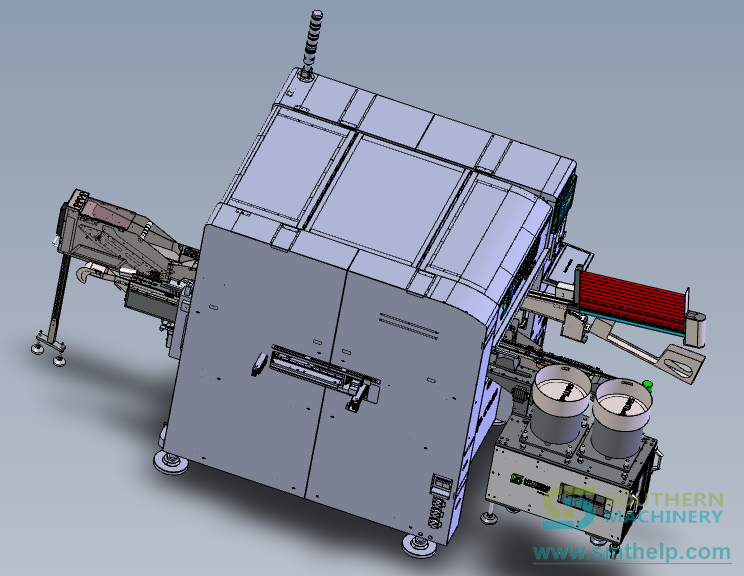
S7900 OddForm Insertion Machine Solution for Smart EMS THT PCB Assembly
S7900 odd-form insertion machine: 2, 4 or 6 servo heads, 0.6-0.8 s per component, 0.6-2.0 mm board, 0-360 degree insertion, four lead-clinching patterns and bowl, tape, tube and tray feeders on one platform. Includes a 36-line THT BOM split and a three-document disclosure table.

S-300B Radial Lead Molding and Taping Machine
S-300B radial lead molding and taping machine: forms the lead pitch, tests polarity and value, then tapes 180 plus or minus 20 components a minute, boxed or reeled.
Request a quote for S3000 Radial Insertion Machine
Send your board, component list or machine model and we reply with a configuration and quotation. Prices are quoted per project.