
SBF1001 Wendelförderer
Schüttgut kommt in einer Kiste an. An der Pipette sollte es sortiert, ausgerichtet und pünktlich ankommen.
Der Wendelförderer SBF1001 automatisiert die Schüttgutzuführung für SMT-Bestücker, Odd-Form-Bestückautomaten und Roboterzellen: Bauteile von 3 x 3 mm bis 50 x 50 mm, 10 g bis 300 g, Zwei-Topf-Gestell 1120 x 460 x 910 mm, 220 V, Druckluft 0,4–0,6 MPa, 0,8 s pro Zuführung, Zuführgenauigkeit ±0,5 mm, Lichtleiter-Positionserkennung, optional Polaritätssortierung und Anschlusskürzung, 2-stündiger Dauerzuführtest und 48-stündiger Alterungstest. Veröffentlichte Spezifikationen, Inbetriebnahme-Checkliste, interaktiver Amortisationsrechner und acht Prozessnotizen von Southern Machinery, Shenzhen.
Der Wendelförderer SBF1001 ist eine Plattform für die Schüttgutzuführung. Er nimmt lose elektronische Bauteile, Kleinteile, Kunststoffteile und Steckverbinder von 3 x 3 mm bis 50 x 50 mm mit 10 g bis 300 g auf, hebt sie auf eine vibrierende Bahn, prüft sie – soweit das Material es zulässt – auf Richtung und Polarität, fördert sie durch direkte Vibration und Luftstoß und stellt sie an einem Aufnahmepunkt mit ±0,5 mm Genauigkeit bereit. Eine Zuführung dauert 0,8 s. Ein Topf bedient ein Material; zwei Töpfe in einem Gestell bedienen zwei. Er läuft mit 220 V, benötigt 0,4–0,6 MPa Werksluft und kommuniziert mit der Host-Maschine über einen 8-poligen…
Wichtigste Merkmale
Schüttgut ist die Verpackung, die niemand eingeplant hat
Gurte und Stangen haben eine Standardschnittstelle. Ein Beutel Steckverbinder, eine Kiste LED-Linsen, ein Tray Kontakte und eine Schachtel Kleinteile nicht. Sie bekommen einen Arbeitstisch, zwei Hände und eine Kunststoffschaufel. Dieser Tisch skaliert nicht mit Ihrem Bestücker, sondern mit Ihrem Personal – und dort treten Lagefehler als Erstes auf, wenn eine Schicht müde wird.
Die Ausrichtung ist das eigentliche Problem, nicht der Transport
Ein Bauteil zu bewegen ist leicht. Es in jedem Zyklus gleich bereitzustellen, ist schwer. Ein Wendelförderer funktioniert, weil die Topfbahn ein mechanischer Filter ist: Nur Teile in der richtigen Lage bleiben auf der Bahn. Alles andere fällt in den Topf zurück und versucht es erneut. Genau diese eine Idee macht aus einer ungeordneten Kiste einen Strom, den eine Pipette aufnehmen kann.
Ein Feeder pro Material ist ein Merkmal, keine Einschränkung
Eine Topfbahn wird für ein Bauteil gefertigt. Deshalb ist ein Wendelförderer so reproduzierbar – und deshalb nimmt er kein beliebiges Teil an. Richtig spezifiziert läuft er jahrelang. Als Universalmaschine behandelt, scheitert er am zweiten Material. Der SBF1001 wird daher als Ein-Topf- oder als Zwei-Topf-Gestell (vorne und hinten) geliefert: zwei Materialien, eine Stellfläche, zwei unabhängige Bahnen.
Spezifikationen
Werte wie in den Unterlagen von Southern Machinery veröffentlicht. Widersprechen sich zwei Quellen, werden beide Werte mit Quelle gezeigt.
| Model | SBF1001 bowl feeder |
|---|---|
| Function | Automated bulk component feeding for SMT/THT machines and non-standard equipment; sorts, screens direction and polarity, cuts and shapes, and enables robotic integration |
| Overall dimensions (L x W x H) | 1120 x 460 x 910 mm (front and rear bowls); 760 x 460 x 910 mm (single bowl) |
| Weight | Double bowls 190 kg; single bowl 150 kg |
| Material types | Electronic components, hardware parts, plastic parts, connectors |
| Material size | 3 x 3 mm up to 50 x 50 mm |
| Material weight | 10 g to 300 g per piece |
| Feeding method | Bulk feeding and vibratory bowl feeding |
| Feeding bowl surface | Single bowl feeding, or front and rear bowl feeding |
| Material conveyance | Direct vibration plus air blowing |
| Material positioning | Optical fibre sensing |
| Fixing method | Positioning key plus clamping block; other fixing structures supported |
| Polarity sorting | Option - selected according to the material |
| Lead cutting | Option - selected according to the material |
| Working voltage | 220 V |
| Average / peak current | 3 A / 5 A |
| Working air pressure | 0.4 - 0.6 MPa |
| Operation method | Button operation on the feeder panel |
| Upper-computer connection | 8-core, 16 mm diameter aviation plug |
| Communication method | IO communication with the host, or self-controlled operation without communication |
| Software control | Developed based on PLC |
| Driving method | Coil driving |
| Feeding speed | 0.8 s |
| Speed gears | Voltage and frequency adjustment |
| Feeding precision | +/-0.5 mm |
| Feeding test | 2 hours of continuous feeding without abnormality |
| Ageing test | 48 hours of continuous operation without abnormality |
Modelle, Vergleiche und offene Punkte
What the SBF1001 will feed, and what it will not (8 Zeilen)
| Fit question | Published answer | Status | What to send us |
|---|---|---|---|
| Which materials can it feed? | Electronic components, hardware parts, plastic parts and connectors, from 3 x 3 mm up to 50 x 50 mm and 10 g to 300 g per piece. | Verified | A sample of each part and its three dimensions |
| Will it sort orientation and polarity? | Direction and polarity screening is documented as an optional function selected according to the material. It is a track feature, so it is decided with the component in hand. | Option | A photo of the part, or the part itself, showing every face |
| Can it cut the leads? | Lead cutting is a second documented option, also selected according to the material. Parts without leads do not need it and are not specified with it. | Option | The lead length needed and the lead diameter |
| How fast is it, and what degree of precision? | A feed takes 0.8 s and the feeding precision is +/-0.5 mm. Speed gears are set by voltage and frequency adjustment rather than by discrete steps. | Verified | The takt your head needs and the number of parts per board |
| How does it connect to my machine? | Through an 8-core, 16 mm aviation plug using IO communication - or standalone with no communication at all. Air at 0.4-0.6 MPa is required in both cases. | Verified | Your machine model, and whether the bank supplies 220 V and air |
| How much room does it take? | 1120 x 460 x 910 mm and 190 kg for the two-bowl frame; 760 x 460 x 910 mm and 150 kg for the single bowl. The four-rail LED variant is documented with a rail intrusion into the machine of only 231 mm. | Verified | A floor plan or a photo of the space beside your mounter |
| What if my part is outside the window? | The bowl platform is customised for other geometries and other track forms, and Southern Machinery documents a 1-month customised solution commitment for these builds. A customised bowl feeder is a documented product, not a special favour. | Verified | The part, the target rate and the machine - we will quote the variant |
| Is one feeder per material really necessary? | Yes, and it is the reason the feeder is reliable. The track is machined for one component geometry. One bowl serves one material; the two-bowl frame serves two materials from one station. Dedicated track parts - rail, setter and separator - are made for your connector, and are replaced if the target component changes. | Verified | Every part number you want fed, so we can size the frame |
Documented commissioning and running checks (6 Zeilen)
| Check | Published criterion | Source | Why it matters |
|---|---|---|---|
| Feeding test | 2 hours of continuous feeding without abnormality | SBF1001 sheet | Proves the track sorts and releases parts for a full shift segment, not just at start-up |
| Ageing test | 48 hours of continuous operation without abnormality | SBF1001 sheet | Covers the coil drive and the control electronics over a full week of production |
| Feeding precision | +/-0.5 mm | SBF1001 sheet | Sets the tolerance the nozzle can rely on at the pick point |
| Feeding speed | 0.8 s per feed | SBF1001 sheet | The floor for takt planning - the head, not the feeder, sets the real cycle |
| Daily inspection | Inspect, clean and lubricate the bowl feeder regularly, per the daily inspection section | MBF-L manual | A bowl feeder is a precision instrument; track cleanliness is what keeps the sorting stable |
| Pick-up position | Re-check component alignment at the pick-up section and the rail after any movement or impact | MBF-L manual | Moving a loaded feeder can tilt the part at the pick point and cause pick-up errors |
Im Detail
Bulk parts are where an automated line stops being automated
Every EMS plant we walk through has the same shape of problem: the pick-and-place side runs at machine speed, and the parts that arrive in a bag, a bin or a tray run at the speed of a wrist. The gap is almost never the placement head. It is the material presentation in front of it.
- Bulk is the packaging nobody planned for. Reels and tubes have a standard interface. A bag of connectors, a bin of LED lenses, a tray of terminals and a box of hardware do not. So they get a bench, a pair of hands and a plastic scoop. That bench does not scale with your mounter - it scales with your headcount, and it is the first place orientation errors appear when a shift gets tired.
- Orientation is the whole problem, not the transport. Moving a part is easy. Presenting it the same way every cycle is the hard part. A bowl feeder works because the bowl track is a mechanical filter: only parts travelling in the right attitude stay on the track. Everything else falls back into the bowl and tries again. That single idea is what turns an unordered bin into a stream a nozzle can pick.
- One feeder per material is a feature, not a limit. A bowl track is machined for one component. That is why a bowl feeder is so repeatable - and why it will not accept an arbitrary part. Specify it honestly and it runs for years. Treat it as a universal machine and it will fail on the second material. The SBF1001 therefore comes as a single-bowl or a front-and-rear two-bowl frame: two materials, one footprint, two independent tracks.
A bowl, a track and a stream of air
The SBF1001 is deliberately simple on the outside and precisely arranged on the inside. Loose material is loaded into the bowl. Coil-driven vibration lifts it up a helical track, where the track geometry sorts it into one attitude and rejects everything that does not fit. A separate vibrating rail carries the aligned parts out of the bowl, air blowing speeds them along and clears the track, an optical fibre confirms a part has arrived, and the component presents at the pick point. The host…
- Load the bulk material. Pour the loose components, hardware, plastic parts or connectors into the bowl. There is no tape, no reel and no tube to thread - that is the point of a bowl feeder. On a JUKI-style bowl feeder the bowl can be replenished while the mounter is still running.
- Vibrate, lift and sort. Coil driving lifts the material up the helical track. The track is machined so that only correctly oriented parts survive the climb; anything upside down, on its side or doubled up falls back into the bowl and recirculates. Speed is set by voltage and frequency adjustment, not by guesswork.
- Screen for direction and polarity. Where the material has a definable direction - a connector keyway, an LED lens with an axis, a polarised capacitor - sorting and polarity screening can be included as an option. It is selected per material, because it is a track feature, not a software setting.
- Trim the lead if the part needs it. Lead cutting is a second documented option, also chosen according to the material. Bulk parts with leads often need the lead trimmed to a fixed length before the nozzle can take them cleanly. Where the part has no leads, this option is simply not specified.
- Convey on the rail by vibration and air. Aligned parts leave the bowl onto a vibrating rail. Direct vibration carries them forward and air blowing accelerates them and keeps the track clear of debris and dust. The rail is the interface to the machine - on the four-rail LED version the whole rail set extending into the mounter is only 231 mm wide.
- Sense, position, present. Optical fibre sensing confirms a part is at the pick point and holds the feed precision at +/-0.5 mm. The part is then presented for the nozzle, gripper or robot arm. If the part is not there, the feeder knows - it does not feed air and let the head pick nothing.
What the SBF1001 will feed, and what it will not
A bowl feeder is a mechanical contract. These are the published limits. If your part sits outside them, say so early - the same bowl platform is customised for other geometries and other track forms, and we would rather quote the variant than sell you the wrong base model.
How the base platform is configured to your line
The SBF1001 is a platform, not a catalogue number. The list below separates what is genuinely configurable from what is fixed, so you can specify it once and correctly.
- Single bowl or two bowls. One bowl for one material, or a front-and-rear frame carrying two independent bowls and two rails. The two-bowl version doubles the materials from one station without doubling the floor space.
- Direction and polarity screening. Track features that reject incorrectly oriented parts and check polarity where the material has one. Selected per material at order, because it is machined into the track.
- Lead cutting on the feeder. Trims the leads to length before the part reaches the pick point, so the nozzle takes a prepared component instead of a raw one. Also selected per material.
- Multi-track and multi-channel bowls. For high-mix programmes, a documented multi-channel bowl is available. The BF200L vibratory bowl feeder is a compact double-layer plate with four tracks that supplies four kinds of material at the same time, at 220 V with a programmable control circuit. The BF220L is the companion model.
- Standalone or host-communicated. Run it on its own buttons, or let the host machine drive it over IO through the 8-core aviation plug. Both modes ship in the same unit; the mode is a setting, not a different feeder.
- Customised geometry and track. For parts outside the published window, or for a connector geometry that needs a dedicated rail, setter and separator, the bowl platform is customised. Southern Machinery documents a 1-month customised solution commitment for these builds.
Commissioning is a same-shift job
There is no software licence, no external compressor beyond the plant air line, and no calibration rig. Six steps take the feeder from the crate to producing parts, and the setting list is small enough to write on the inside of a cabinet door.
- Unbox and inspect. Check the bowl, the rail, the power lead, the air line and the mounting hardware against the packing list. Confirm the bowl has not been distorted in transit - a bowl is a tuned mechanism, and a dent changes how it sorts.
- Mount on the positioning key. Seat the feeder on its positioning key and clamp it with the clamping block. Other fixing structures are supported, but the key-and-block mount is a mechanical datum: it lets a feeder be removed, swapped and re-seated square without re-datuming the rail height.
- Power and air. Connect the 220 V supply and bring the air line in at 0.4-0.6 MPa. Average current is 3 A with 5 A peak. If the host communicates with the feeder, connect the 8-core, 16 mm aviation plug. Never short the supply - that damages the control board.
- Load the material and set the rate. Pour the bulk material into the bowl and set the speed gear by voltage and frequency adjustment. Start slow. A bowl that is over-driven throws parts off the track instead of sorting them, which looks like a tooling fault and is really a rate setting.
- Confirm the track and the pick point. Run the bowl empty of everything except the target part and watch the track: only correctly oriented parts should reach the rail. Then confirm the optical fibre triggers at the pick point and that the part presents square to the nozzle before the head is allowed to pick.
- Validate before you run production. Run the documented validation: a continuous feed test and a powered ageing run. Then clean the track and the fibre head, lock the settings, and log them per part number so the next changeover is a recall rather than a re-tune.
- Documented commissioning and running checks. The SBF1001 specification sheet publishes the acceptance tests the feeder is released against, and the MBF-L bowl feeder manual documents the running checks a bowl feeder needs. Together they form a commissioning checklist you can hold us to. Values below are the published ones - they are the release criteria, not a promise about your material, which is why the sample test matters.
What happens after the feeder arrives
A bowl feeder is judged in year three, not on the delivery note. These are the published service commitments.
Videos
Clips aus dem YouTube-Kanal von Southern Machinery. Von YouTube wird erst etwas geladen, wenn Sie auf Abspielen drücken.
Kataloge und Dokumente
- 3DSearch the full video board - 1,248 machine working videos across 14 categories
- 3DSMT odd-form bowl feeder - interactive 3DInteractive 3D previews
- 3D2-in-1 vibration bowl feeder - interactive 3DInteractive 3D previews
- 3DTwo bowl feeders in one odd-form solutionInteractive 3D previews
- 3DFour bowl feeders in one odd-form solutionInteractive 3D previews
- 3DOdd-form insertion with three bowl feedersInteractive 3D previews
- 3DTerminal, PIN and eyelet inserter with bowl feedingInteractive 3D previews
- HTMLS-MVF01 belt bulk feeder - landing pageLanding pages and guides
- HTMLBulk terminal feeder - landing pageLanding pages and guides
- HTMLSMT/THT customized feeder - landing pageLanding pages and guides
- HTMLCustomized feeder design and manufacturingLanding pages and guides
- HTMLSMT feeder and nozzle solutions seriesLanding pages and guides
- HTMLFeeders, nozzles and material supplyLanding pages and guides
- PDFSBF1001 bowl feeder specification sheet - catalogue V03Specifications, boards and tools
- PDFBF200L LED lens vibratory bowl feeder - four-trackSpecifications, boards and tools
- PDFBelt feeder versus bowl feeder - comparisonSpecifications, boards and tools
- HTMLFull machine catalogue boardSpecifications, boards and tools
- XLSXTHT insertion ROI calculatorSpecifications, boards and tools
Technische Notizen
INSIGHT 01The bench nobody budgeted for
Every mixed-technology line has a table where somebody sorts connectors, lenses or terminals out of a bin by hand. It is usually treated as a staffing issue. It is a material-presentation issue wearing a staffing costume. Walk onto most EMS floors and the SMT side is quiet, fast and measured. Then you reach the…
INSIGHT 02Your odd-form cell is not slow, its material presentation is
When a bulk-fed cell misses its output target, the head gets blamed. Most of the time the head is fine and the material interface in front of it is not. A cell that runs one product all week will look excellent on any benchmark. The same cell running four product families a day can look broken - same head, same…
INSIGHT 03The five-number bulk feeding audit
Before you price a feeder, price the problem. Five measurements taken on your own floor will tell you whether a bowl feeder pays for itself - and whether you should buy one at all. Most feeder decisions are made backwards: a supplier quotes, the plant manager asks for a discount, and somewhere in the middle nobody…
INSIGHT 04Orientation, polarity and rate: the three settings that decide bulk feeding yield
Bulk feeding problems are usually described as quality problems. They are almost always three settings on the feeder that were never specified together. A part that arrives upside down, or reversed, or two at a time, is a symptom. The cause is normally upstream of the nozzle, in three things that nobody wrote down…
INSIGHT 05Stop buying insertion machines. Start buying feeding.
Plants that struggle with through-hole automation usually already own the machine. What they do not own is a reliable way to present the part to it. Ask a plant manager what limits through-hole automation and the answer is usually the inserter. Ask what actually stops the cell and the answer is much more specific:…
INSIGHT 06From two shifts of hand-feeding to one: the arithmetic
Labour reduction is the easiest claim in this industry to make and the easiest to disprove. So here is the arithmetic, laid out so you can attack it with your own numbers. Somebody in the plant says the bulk bench needs two shifts. Somebody else says automation is too expensive. Both statements feel true and neither…
Vollständige Artikel auf der interaktiven Produktseite lesen →
Häufige Fragen
Welche Bauteile kann der Wendelförderer SBF1001 zuführen?
Elektronische Bauteile, Kleinteile, Kunststoffteile und Steckverbinder von 3 x 3 mm bis 50 x 50 mm und 10 g bis 300 g pro Stück. Ist Ihr Teil ein loses, formstabiles Teil innerhalb dieses Bereichs, lässt es sich sehr wahrscheinlich zuführen – senden Sie ein Muster, wir bestätigen die Bahn.
Kann ein Wendelförderer zwei verschiedene Bauteile zuführen?
Nicht in einem Topf. Die Sortierbahn ist für eine Bauteilgeometrie gefertigt, und genau deshalb ist der Feeder reproduzierbar. Sie können aber das Gestell mit Topf vorne und hinten bestellen: zwei unabhängige Töpfe, zwei Schienen, zwei Materialien, eine Station von 1120 x 460 x 910 mm. Mehrkanal-Töpfe sind zudem für Vier-Material-Programme wie LED-Linsen dokumentiert.
Wie schnell ist er, und mit welchem Takt sollte ich planen?
Eine Zuführung dauert 0,8 s, die Zuführgenauigkeit beträgt ±0,5 mm. In der Praxis bestimmt der Bestückkopf den Takt – Aufgabe des Feeders ist es, ihn nie leerlaufen zu lassen. Planen Sie den Takt nach Kopf und Platine und betrachten Sie die 0,8 s als Reserve.
Beherrscht er Polarität und Ausrichtung?
Die Lagesortierung ist systembedingt – sie ergibt sich aus der Bahngeometrie, und jedes Teil in falscher Lage fällt in den Topf zurück. Die Polaritätsprüfung ist eine dokumentierte Option, die je nach Material gewählt wird, weil sie ein Bahnmerkmal und keine Softwareeinstellung ist. Senden Sie uns das Teil, und wir sagen Ihnen, was Sie brauchen.
Was benötigt er vom Werk?
220 V bei durchschnittlich 3 A und 5 A Spitze, Arbeitsluft mit 0,4–0,6 MPa und – wenn Sie IO-Kommunikation wünschen – eine Verbindung zur Host-Maschine über einen 8-poligen 16-mm-Rundsteckverbinder. Kein externer Kompressor über die Werksluft hinaus, keine Softwarelizenz und kein separater Steuerschrank.
Was passiert, wenn der Topf leer läuft oder ein Teil klemmt?
Die Materialpositionierung erfolgt per Lichtleitersensor, der Feeder weiß also, ob tatsächlich ein Teil am Aufnahmepunkt liegt, statt Zyklen zu zählen. Die meisten Sortierprobleme sind Geschwindigkeitsprobleme: Ein übersteuerter Topf wirft Teile von der Bahn, statt sie zu sortieren. Reduzieren Sie zuerst die Geschwindigkeitsstufe, prüfen Sie dann die Bahn auf Fremdkörper und den Lichtleiterkopf auf Staub.
Was sollte ich auf Lager halten?
Halten Sie die Verschleißteile vor, die Ihr eigenes Protokoll ausweist, und verlassen Sie sich auf die dokumentierte Ersatzteil-Lieferzeit von 1 Tag, statt ein Lager aufzubauen. Die für Sie spezifischen Teile sind die Bahnteile – Schiene, Einsteller und Separator –, notieren Sie daher die Teilenummern, die wir für Ihren Steckverbinder gefertigt haben. Das günstigste Ersatzteil ist eine Einstellung, die Sie wiederfinden.
Wie erhalte ich ein Angebot?
Senden Sie ein Muster jedes Bauteils, seine drei Abmessungen und sein Gewicht in Gramm, ein Foto aus jedem Winkel, Ihr Maschinenmodell, ob Sie Polaritätsprüfung oder Anschlusskürzung brauchen, und Ihre Zielrate an info@smthelp.com oder per WhatsApp an +86 13602562576. Sie erhalten eine Feederkonfiguration, eine Optionsliste und einen Vorschlag für ein Ersatzteilset – und liegt das Teil außerhalb des veröffentlichten Bereichs, eine kundenspezifische Variante statt einer Absage.
Ähnliche Produkte
Odd-Form-Feeder- und Pipetten-Matcher, Katalog V03
Ordnen Sie Odd-Form-THT-Bauteile dem passenden Feeder und der passenden Pipette zu: 76 reale Stücklistenpositionen, 10 Feedermodelle aus Katalog V03 (Stange, Tray, Wendelförderer, Band, radial, axial, Rolle), Filter nach Raster und Gehäusegröße, kostenlose Machbarkeitsprüfung.

SMT-Feeder-Kalibriervorrichtung für FUJI NXT (S-FFCJ10)
SMT-Feeder-Kalibriervorrichtung S-FFCJ10 von Southern Machinery für FUJI-NXT-Feeder: 50-fache CCD-Abbildung, digitale X-Y-Mikrometer, Nullung mit Meisterlehre, Prüfung der Aufnahmeposition auf ±0,25 mm, Kontrollzonen für 8/12/16/24 mm. Spezifikation, Videos, Dokumente und Angebot.
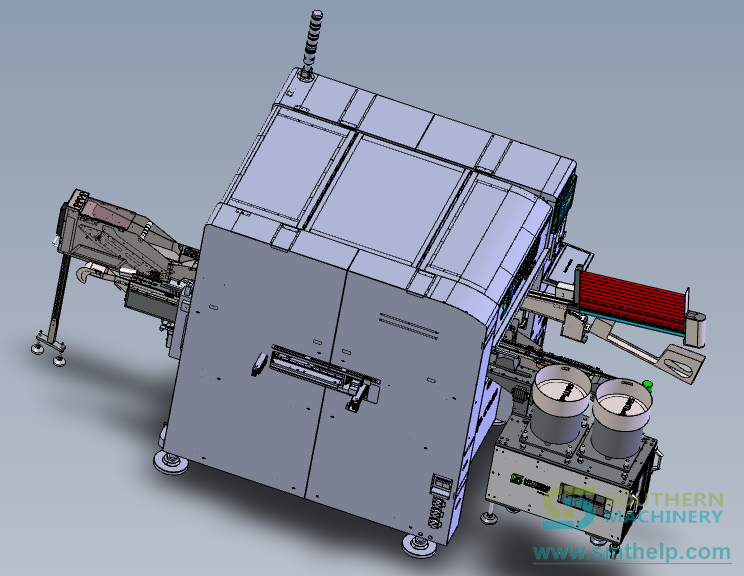
S7900 Odd-Form-Bestückautomat – Lösung für die smarte EMS-THT-Leiterplattenbestückung
Odd-Form-Bestückautomat S7900: 2, 4 oder 6 Servoköpfe, 0,6–0,8 s pro Bauteil, Platinendicke 0,6–2,0 mm, Bestückung 0–360 Grad, vier Umbiegemuster und Wendel-, Gurt-, Stangen- und Trayfeeder auf einer Plattform. Mit Aufteilung einer 36-zeiligen THT-Stückliste und einer Offenlegungstabelle aus drei Dokumenten.

Axialbestückautomat S4000 für die smarte EMS-THT-Leiterplattenbestückung
Axialbestücker S4000: veröffentlichte Höchstgeschwindigkeit 20.000 CPH, 5–60 modulare Feederstationen, Bestückung in jedem Winkel auf einem Servo-Drehtisch, doppelte Drahtbrücken-Feeder, Platinendicke 0,79–2,36 mm, Platinen 50 x 50 bis 400 x 300 mm. Servoangetrieben, EtherCAT, MES-fähig.

S-300B Radial-Biege- und Gurtmaschine
Radial-Biege- und Gurtmaschine S-300B: formt das Anschlussraster, prüft Polarität und Wert und gurtet dann 180 ± 20 Bauteile pro Minute, in Box oder auf Rolle.
Einige technische Angaben auf dieser Seite (Tabellen, Dokumenttitel) erscheinen wie veröffentlicht auf Englisch.
Angebot anfordern: SBF1001 Wendelförderer
Senden Sie Ihre Platine, Bauteilliste oder Ihr Maschinenmodell, und wir antworten mit einer Konfiguration und einem Angebot. Preise werden projektbezogen kalkuliert.