
SMT-Feeder-Kalibriervorrichtung für FUJI NXT (S-FFCJ10)
SMT-Feeder-Kalibriervorrichtung von Southern Machinery
SMT-Feeder-Kalibriervorrichtung S-FFCJ10 von Southern Machinery für FUJI-NXT-Feeder: 50-fache CCD-Abbildung, digitale X-Y-Mikrometer, Nullung mit Meisterlehre, Prüfung der Aufnahmeposition auf ±0,25 mm, Kontrollzonen für 8/12/16/24 mm. Spezifikation, Videos, Dokumente und Angebot.
Eine Tischvorrichtung, die Aufnahmeposition, Höhe und Gurtvorschub eines Feeders prüft, bevor ein driftender Feeder Ausschuss produziert. 50-fache CCD-Abbildung, digitale X-Y-Mikrometer und Nullung mit Meisterlehre – entwickelt und gebaut in Shenzhen, weltweit geliefert.
- 350 × 500 × 550 mm
- Stellfläche der Maschine
- 45 kg
- Gewicht – siehe Hinweis im Dokument
- 50×
- CCD-Vergrößerung
- ±0.25 mm
- Akzeptanzgrenze X-Achse
Eine eng verwandte Seite behandelt dieselbe Feeder-Kalibrierstation: SMT-Feeder-Kalibriervorrichtung – visuelle Prüfung der Feedergenauigkeit für die smarte EMS-Leiterplattenbestückung (Bauteilvorbereitung).
Wichtigste Merkmale
Abweichung der Zuführposition
Die Pipette trifft außermittig auf; Bauteile werden schräg aufgenommen oder ganz verfehlt, und der Fehler wiederholt sich am selben Steckplatz Schicht für Schicht.
Hohe Abwurfquote
Bauteile werden mitten im Zyklus verworfen. Die Ausschusszahl steigt unbemerkt, während die Linie weiterläuft – die teuerste Art, einen verbogenen Feederkörper zu entdecken.
Gehäufte Fehlerraten
Ein ganzer Abschnitt von Platinen fällt im selben Test durch. Ein Feeder liefert ein Bauteil auf jede Platine, ein mechanischer Fehler zieht sich also durch das ganze Los.
Verlorene Produktionseffizienz
Jedes manuelle Neueinlernen, jede Probebestückung und jeder Linienstopp kostet Stunden, die Sie nicht abrechnen können – und nichts davon behebt die mechanische Ursache.
Spezifikationen
Werte wie in den Unterlagen von Southern Machinery veröffentlicht. Widersprechen sich zwei Quellen, werden beide Werte mit Quelle gezeigt.
| Working voltage | 220 V / AC (50 Hz), 60 W · Operation manual · Product sheet |
|---|---|
| Power supply | 220 V, 50 Hz · Product sheet |
| Machine size | 350 × 500 × 550 mm · Operation manual · Product sheet |
| Machine weight | 45 kg · Operation manual · Product sheet |
| Material | Aluminum and iron · Product sheet |
| Air pressure | 5 kg/cm² · Product sheet |
| Visual system | 50× magnification CCD camera · Product sheet |
| Lighting system | Ring LED lighting · Product sheet |
| Display system | Ultra-bright LED color display · Product sheet |
| Feeder control zones | 8×2 / 12×4 / 16×8 / 24×8 mm · Product sheet |
| X-axis acceptance limit | ±0.25 mm (manufacturer specification) · smthelp.com product page |
| Calibration modes | Electric and pneumatic variants listed To be confirmed · Distributor listings |
| Weight | 45 kg · about 35 kg · Manual & product sheet vs. distributor listing |
| Machine size | 350 × 500 × 550 mm · L500 × W350 × H550 mm · Manual & product sheet vs. distributor listing |
Im Detail
Four symptoms that all trace back to feeder drift
A feeder that drifts does not announce itself. It shows up as a throw rate that climbs for a week, then as a patch of failed boards, then as a customer call. These four symptoms are the ones our customers name first.
- Feeding position deviation. The nozzle arrives off-center; components are picked at an angle or missed entirely, and the error repeats on the same slot shift after shift.
- High deposit (throw) rate. Components are discarded mid-cycle. The scrap count climbs quietly while the line keeps running — the most expensive way to discover a bent feeder body.
- Patches of defective rate. A whole section of boards fails the same test. One feeder feeds one part on every board, so a mechanical fault prints itself across the run.
- Lost production efficiency. Every manual re-teach, trial placement and line stop burns hours you cannot invoice — and none of it fixes the mechanical cause.
What the jig actually is
Not a software offset. A physical reference the feeder is checked against — the same reference, read the same way, on every shift.
- Calibration jig base. A machined base with interchangeable sub-bases. One base serves CP-4, CP-6 and IP/QP BFC style feeders — the sub-base, not the bench, is what changes per feeder family.
- X-Y digital micrometers. The pickup point read to a hundredth of a millimetre. X reveals a bent feeder body; Y is adjusted through the feeder's own eccentric screw until the mark centers.
- Master gauge and tool scope. Zero the crosshairs on the gauge's calibration circle, then read the feeder's steel tape against the same reference. Verification against hardware, not memory.
- Feeder control zones. Precise 8×2, 12×4, 16×8 and 24×8 mm feeder control zones cover the tape widths running on your line, so the tape advances against the correct-width reference.
Five steps from crate to verified feeder
The whole check is one operator and five minutes per feeder. The steps below follow the operation manual shipped with the jig.
- Switch on and self-check. Connect the signal wire to the display VIDEO plug and the power supply. On power-up the press-pole returns to its original position and the display shows a cross cursor — the jig has completed its self-check.
- Install the sub-base. Slide the sub-base for your feeder style forward to the 1st alignment pin (CP-4 / CP-6) or the 2nd pin (IP/QP), keep it against the right-hand guide, then tighten the locking screw.
- Zero on the master gauge. Seat the master gauge on the sub-base, focus the tool scope, center the crosshairs on the gauge's calibration circle with the micrometers, then press zero on the X and Y micrometers.
- Read the feeder. Load the correct-width steel tape into the feeder and place it on the sub-base. Advance it — by turning the feeder advancement cam clockwise for CP-4/CP-6, by hand for IP/QP — and check the tape hole against the crosshairs on screen.
- Adjust or reject. Y: loosen the locknut on the eccentric screw and adjust until the mark centers. X: no adjustment exists — beyond ±0.25 mm the feeder body is bent and the unit goes to repair, not back to the line.
One jig, many feeder families
The S-FFCJ10 ships as the FUJI NXT configuration. The same platform covers the feeder families below; the sub-base, pedestal and control-zone set are confirmed per machine model when you order.
Videos
Clips aus dem YouTube-Kanal von Southern Machinery. Von YouTube wird erst etwas geladen, wenn Sie auf Abspielen drücken.
Kataloge und Dokumente
- 3DSouthern-Machinery-YouTube-Video-Board
- PDFFeeder Calibration Jig Operation Manual
- PDFSMT Feeder Calibration jig product sheet
- 3DFUJI NXT M3 mounter — 3D preview
- 3DSMT tube feeder — FUJI NXT — 3D preview
- 3DFUJI NXT 8 mm feeder — 3D preview
- 3DFUJI Sfab radial tape feeder — 3D preview
- 3DSouthern-Machinery-Product-Catalog-Board
- LINKBrowse the full machine catalog →
Technische Notizen
The 2 a.m. Alarm: What One Drifting Feeder Really Costs Your Line
A feeder that drifts 0.3 mm does not announce itself. It shows up as a throw rate that climbs for a week, then as a patch of failed boards, then as a customer call. Here is the cost chain, in the order you will feel it. It starts with a sound, not a number. A placement head hesitates over one slot, twice in a shift,…
Recalibrated Last Month, Drifting Again? Here Is Why
If pickup errors keep returning after every re-teach, the cause is usually mechanical — a bent feeder body, a worn sprocket, or an eccentric screw that was never centered against a physical reference. You re-taught the coordinates. The line ran clean for three weeks. Now the same slot is throwing components again,…
The Five-Minute Feeder Check That Finds Drift Before Scrap Does
A standing check any shift leader can run: steel tape in the feeder, crosshairs zeroed on the master gauge, read the hole, record the number. No software, no guesswork. Most feeder drift is found by the scrap bin. It does not have to be. A standing check takes five minutes per feeder and needs no software: seat the…
Inside the S-FFCJ10: What a Calibration Jig Actually Measures
X and Y pickup position on digital micrometers, pickup and press-pole height on the bench, tape advance against the correct-width control zone — measured, not assumed. It is tempting to file a calibration jig under 'fixture' and move on. It is worth knowing what it measures, because that is what it can catch. Three…
One Feeder Fixed Is a Favor. A Feeder Schedule Is a System.
Heroics do not survive a shift change. A standing calibration schedule — after repair, after collision, after long storage, after repeated pickup errors — does. Every plant has the engineer who can coax a drifting feeder back to life. Very few plants have a schedule that would have caught the drift before it…
±0.25 mm: The Number That Separates Adjustment From Replacement
The manufacturer's acceptance limit is not bureaucracy. Beyond ±0.25 mm in X there is nothing to adjust — the feeder body is bent, and the only correct move is repair or replacement. A tolerance is a decision that has already been made for you. ±0.25 mm in the X direction is that kind of number. Within the limit, the…
Vollständige Artikel auf der interaktiven Produktseite lesen →
Häufige Fragen
Welche FUJI-Feeder deckt die S-FFCJ10 ab?
Die FUJI-NXT-Konfiguration deckt Feeder der Bauarten CP-4, CP-6 und IP/QP BFC über austauschbare Unterbauten ab. Bestätigen Sie Ihre genaue Feedergeneration vor der Bestellung mit unserem Team.
Funktioniert sie auch mit Feedern anderer Hersteller als FUJI?
Dieselbe Plattform deckt die Familien Panasonic CM, I-PULS M2/M20, SIEMENS, SAMSUNG SM und CP, SONY, YAMAHA YS, UNIVERSAL und PHILIPS ab. Unterbau und Sockel werden je Maschinenmodell ausgewählt.
Wie lautet die Akzeptanzgrenze?
±0,25 mm in X-Richtung laut Herstellerspezifikation. Jenseits der Grenze ist keine Justage möglich – der Feederkörper ist verbogen, und das Gerät geht in die Reparatur.
Welche Strom- und Luftversorgung benötigt sie?
220 V AC (50 Hz), 60 W. Pneumatische Varianten benötigen Druckluft mit 5 kg/cm². Händler führen sowohl elektrische als auch pneumatische Varianten; bestätigen Sie die Variante für Ihre Konfiguration vor der Bestellung.
Wie groß und wie schwer ist sie?
45 kg und 350 × 500 × 550 mm laut Bedienungsanleitung und Produktblatt. Ein Händlereintrag nennt etwa 35 kg bei gleichen Abmessungen in anderer Achsreihenfolge – beide Werte stehen im Abschnitt Spezifikationen.
Wie bestellen wir?
Schreiben Sie an info@smthelp.com oder per WhatsApp mit Ihrem Maschinenmodell, den Feederbauarten und den Monatsmengen. Wir bestätigen die Konfiguration und erstellen ein Angebot – in der Regel innerhalb eines Arbeitstages.
Ähnliche Produkte

SMT-Feeder-Kalibriervorrichtung – visuelle Prüfung der Feedergenauigkeit für die smarte EMS-Leiterplattenbestückung
Prüfen Sie Aufnahmeposition, Vorschubbewegung und Ausrichtung eines Feeders, bevor er zurück in die SMT-Linie geht. CCD-Kamera, LCD-Monitor, X/Y/H-Justage, FUJI-NXT-Aufnahme. 220 V, 45 kg – alle Werte mit Quellenangabe.
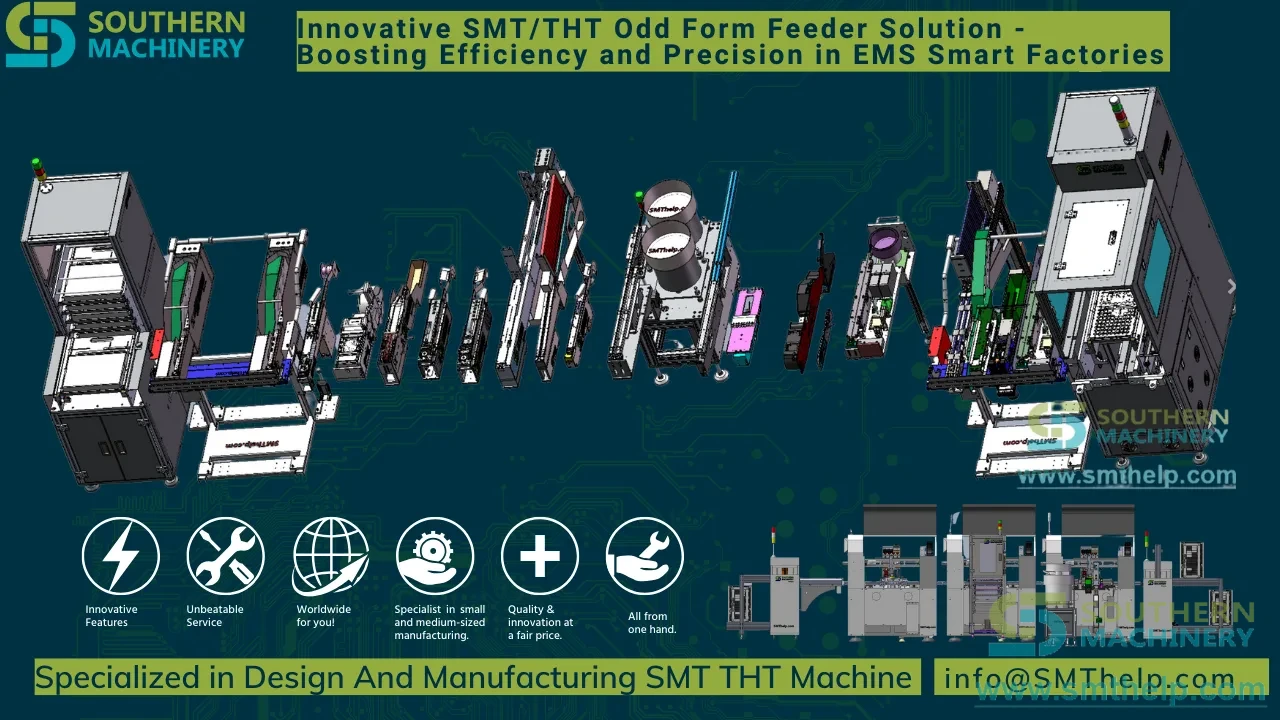
Odd-Form-Feeder- und Pipetten-Matcher, Katalog V03
Ordnen Sie Odd-Form-THT-Bauteile dem passenden Feeder und der passenden Pipette zu: 76 reale Stücklistenpositionen, 10 Feedermodelle aus Katalog V03 (Stange, Tray, Wendelförderer, Band, radial, axial, Rolle), Filter nach Raster und Gehäusegröße, kostenlose Machbarkeitsprüfung.
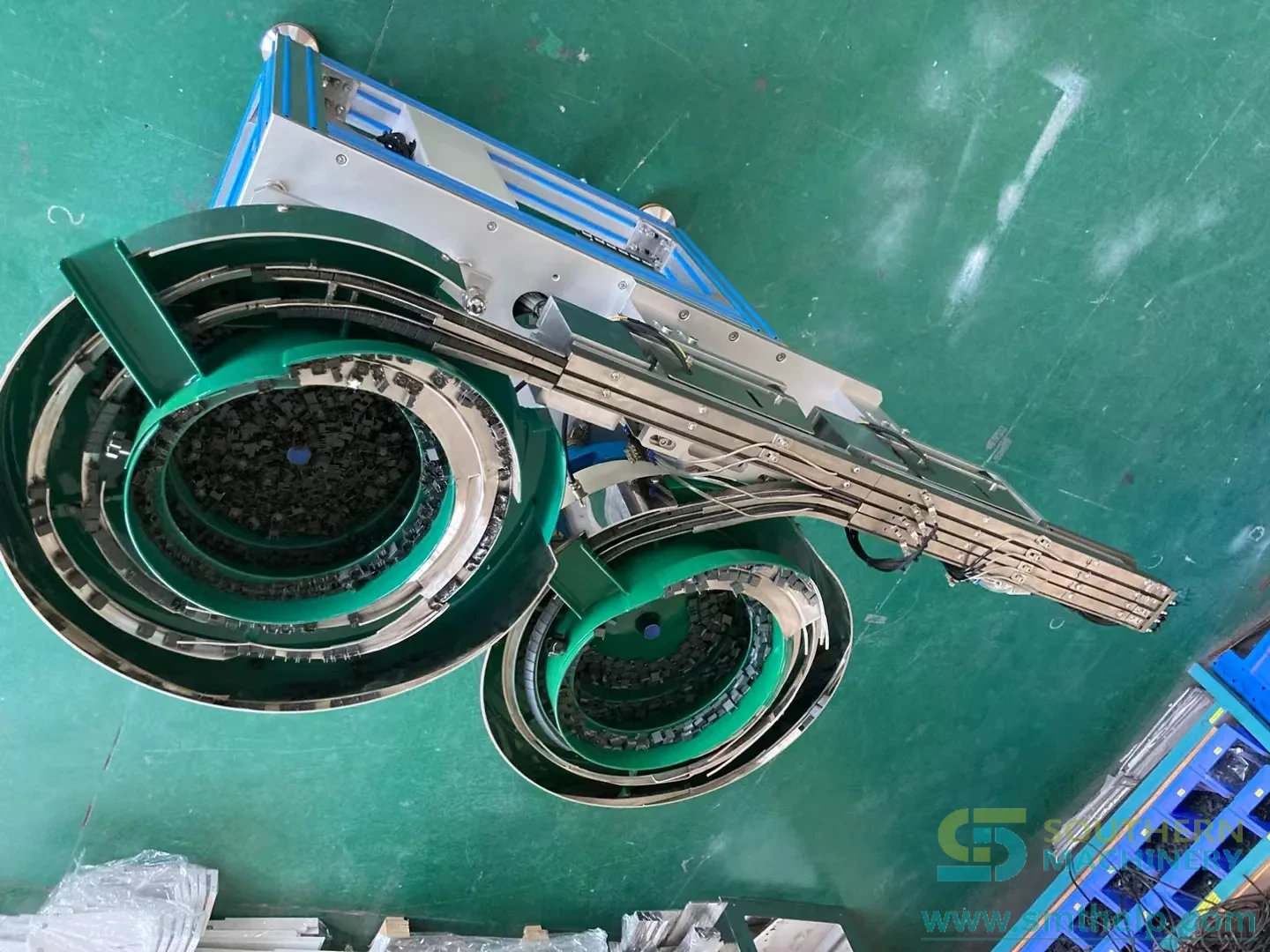
SBF1001 Wendelförderer
Der Wendelförderer SBF1001 automatisiert die Schüttgutzuführung für SMT-Bestücker, Odd-Form-Bestückautomaten und Roboterzellen: Bauteile von 3 x 3 mm bis 50 x 50 mm, 10 g bis 300 g, Zwei-Topf-Gestell 1120 x 460 x 910 mm, 220 V, Druckluft 0,4–0,6 MPa, 0,8 s pro Zuführung, Zuführgenauigkeit ±0,5 mm, Lichtleiter-Positionserkennung, optional Polaritätssortierung und Anschlusskürzung, 2-stündiger Dauerzuführtest und 48-stündiger Alterungstest. Veröffentlichte Spezifikationen, Inbetriebnahme-Checkliste, interaktiver Amortisationsrechner und acht Prozessnotizen von Southern Machinery, Shenzhen.
Einige technische Angaben auf dieser Seite (Tabellen, Dokumenttitel) erscheinen wie veröffentlicht auf Englisch.
Angebot anfordern: SMT-Feeder-Kalibriervorrichtung für FUJI NXT (S-FFCJ10)
Senden Sie Ihre Platine, Bauteilliste oder Ihr Maschinenmodell, und wir antworten mit einer Konfiguration und einem Angebot. Preise werden projektbezogen kalkuliert.