
SBF1001 Vibratory Bowl Feeder
Bulk parts arrive in a bin. They should reach the nozzle sorted, oriented and on time.
The SBF1001 vibratory bowl feeder automates bulk component supply for SMT mounters, odd-form inserters and robotic cells: 3 x 3 mm to 50 x 50 mm parts, 10 g to 300 g, 1120 x 460 x 910 mm two-bowl frame, 220 V, 0.4-0.6 MPa air, 0.8 s per feed, +/-0.5 mm feeding precision, optical fibre positioning, optional polarity sorting and lead cutting, 2-hour continuous feeding test and 48-hour ageing test. Published specifications, the commissioning checklist, an interactive payback calculator and eight process notes from Southern Machinery, Shenzhen.
The SBF1001 bowl feeder is a bulk component supply platform. It takes loose electronic components, hardware, plastic parts and connectors from 3 x 3 mm up to 50 x 50 mm, weighing 10 g to 300 g, lifts them onto a vibrating track, screens them for direction and polarity where the material allows it, conveys them by direct vibration and air blowing, and presents them at a pick point with +/-0.5 mm precision. One feed takes 0.8 s. One bowl serves one material; two bowls in one frame serve two. It runs on 220 V, needs 0.4-0.6 MPa of plant air, and talks to the host machine through an 8-core…
Key features
Bulk is the packaging nobody planned for
Reels and tubes have a standard interface. A bag of connectors, a bin of LED lenses, a tray of terminals and a box of hardware do not. So they get a bench, a pair of hands and a plastic scoop. That bench does not scale with your mounter - it scales with your headcount, and it is the first place orientation errors appear when a shift gets tired.
Orientation is the whole problem, not the transport
Moving a part is easy. Presenting it the same way every cycle is the hard part. A bowl feeder works because the bowl track is a mechanical filter: only parts travelling in the right attitude stay on the track. Everything else falls back into the bowl and tries again. That single idea is what turns an unordered bin into a stream a nozzle can pick.
One feeder per material is a feature, not a limit
A bowl track is machined for one component. That is why a bowl feeder is so repeatable - and why it will not accept an arbitrary part. Specify it honestly and it runs for years. Treat it as a universal machine and it will fail on the second material. The SBF1001 therefore comes as a single-bowl or a front-and-rear two-bowl frame: two materials, one footprint, two independent tracks.
Specifications
Figures as published in Southern Machinery documents. Where two sources disagree, both values are shown with their source.
| Model | SBF1001 bowl feeder |
|---|---|
| Function | Automated bulk component feeding for SMT/THT machines and non-standard equipment; sorts, screens direction and polarity, cuts and shapes, and enables robotic integration |
| Overall dimensions (L x W x H) | 1120 x 460 x 910 mm (front and rear bowls); 760 x 460 x 910 mm (single bowl) |
| Weight | Double bowls 190 kg; single bowl 150 kg |
| Material types | Electronic components, hardware parts, plastic parts, connectors |
| Material size | 3 x 3 mm up to 50 x 50 mm |
| Material weight | 10 g to 300 g per piece |
| Feeding method | Bulk feeding and vibratory bowl feeding |
| Feeding bowl surface | Single bowl feeding, or front and rear bowl feeding |
| Material conveyance | Direct vibration plus air blowing |
| Material positioning | Optical fibre sensing |
| Fixing method | Positioning key plus clamping block; other fixing structures supported |
| Polarity sorting | Option - selected according to the material |
| Lead cutting | Option - selected according to the material |
| Working voltage | 220 V |
| Average / peak current | 3 A / 5 A |
| Working air pressure | 0.4 - 0.6 MPa |
| Operation method | Button operation on the feeder panel |
| Upper-computer connection | 8-core, 16 mm diameter aviation plug |
| Communication method | IO communication with the host, or self-controlled operation without communication |
| Software control | Developed based on PLC |
| Driving method | Coil driving |
| Feeding speed | 0.8 s |
| Speed gears | Voltage and frequency adjustment |
| Feeding precision | +/-0.5 mm |
| Feeding test | 2 hours of continuous feeding without abnormality |
| Ageing test | 48 hours of continuous operation without abnormality |
Models, comparisons and open points
What the SBF1001 will feed, and what it will not (8 rows)
| Fit question | Published answer | Status | What to send us |
|---|---|---|---|
| Which materials can it feed? | Electronic components, hardware parts, plastic parts and connectors, from 3 x 3 mm up to 50 x 50 mm and 10 g to 300 g per piece. | Verified | A sample of each part and its three dimensions |
| Will it sort orientation and polarity? | Direction and polarity screening is documented as an optional function selected according to the material. It is a track feature, so it is decided with the component in hand. | Option | A photo of the part, or the part itself, showing every face |
| Can it cut the leads? | Lead cutting is a second documented option, also selected according to the material. Parts without leads do not need it and are not specified with it. | Option | The lead length needed and the lead diameter |
| How fast is it, and what degree of precision? | A feed takes 0.8 s and the feeding precision is +/-0.5 mm. Speed gears are set by voltage and frequency adjustment rather than by discrete steps. | Verified | The takt your head needs and the number of parts per board |
| How does it connect to my machine? | Through an 8-core, 16 mm aviation plug using IO communication - or standalone with no communication at all. Air at 0.4-0.6 MPa is required in both cases. | Verified | Your machine model, and whether the bank supplies 220 V and air |
| How much room does it take? | 1120 x 460 x 910 mm and 190 kg for the two-bowl frame; 760 x 460 x 910 mm and 150 kg for the single bowl. The four-rail LED variant is documented with a rail intrusion into the machine of only 231 mm. | Verified | A floor plan or a photo of the space beside your mounter |
| What if my part is outside the window? | The bowl platform is customised for other geometries and other track forms, and Southern Machinery documents a 1-month customised solution commitment for these builds. A customised bowl feeder is a documented product, not a special favour. | Verified | The part, the target rate and the machine - we will quote the variant |
| Is one feeder per material really necessary? | Yes, and it is the reason the feeder is reliable. The track is machined for one component geometry. One bowl serves one material; the two-bowl frame serves two materials from one station. Dedicated track parts - rail, setter and separator - are made for your connector, and are replaced if the target component changes. | Verified | Every part number you want fed, so we can size the frame |
Documented commissioning and running checks (6 rows)
| Check | Published criterion | Source | Why it matters |
|---|---|---|---|
| Feeding test | 2 hours of continuous feeding without abnormality | SBF1001 sheet | Proves the track sorts and releases parts for a full shift segment, not just at start-up |
| Ageing test | 48 hours of continuous operation without abnormality | SBF1001 sheet | Covers the coil drive and the control electronics over a full week of production |
| Feeding precision | +/-0.5 mm | SBF1001 sheet | Sets the tolerance the nozzle can rely on at the pick point |
| Feeding speed | 0.8 s per feed | SBF1001 sheet | The floor for takt planning - the head, not the feeder, sets the real cycle |
| Daily inspection | Inspect, clean and lubricate the bowl feeder regularly, per the daily inspection section | MBF-L manual | A bowl feeder is a precision instrument; track cleanliness is what keeps the sorting stable |
| Pick-up position | Re-check component alignment at the pick-up section and the rail after any movement or impact | MBF-L manual | Moving a loaded feeder can tilt the part at the pick point and cause pick-up errors |
In detail
A bowl, a track and a stream of air
The SBF1001 is deliberately simple on the outside and precisely arranged on the inside. Loose material is loaded into the bowl. Coil-driven vibration lifts it up a helical track, where the track geometry sorts it into one attitude and rejects everything that does not fit. A separate vibrating rail carries the aligned parts out of the bowl, air blowing speeds them along and clears the track, an optical fibre confirms a part has arrived, and the component presents at the pick point. The host…
- Load the bulk material. Pour the loose components, hardware, plastic parts or connectors into the bowl. There is no tape, no reel and no tube to thread - that is the point of a bowl feeder. On a JUKI-style bowl feeder the bowl can be replenished while the mounter is still running.
- Vibrate, lift and sort. Coil driving lifts the material up the helical track. The track is machined so that only correctly oriented parts survive the climb; anything upside down, on its side or doubled up falls back into the bowl and recirculates. Speed is set by voltage and frequency adjustment, not by guesswork.
- Screen for direction and polarity. Where the material has a definable direction - a connector keyway, an LED lens with an axis, a polarised capacitor - sorting and polarity screening can be included as an option. It is selected per material, because it is a track feature, not a software setting.
- Trim the lead if the part needs it. Lead cutting is a second documented option, also chosen according to the material. Bulk parts with leads often need the lead trimmed to a fixed length before the nozzle can take them cleanly. Where the part has no leads, this option is simply not specified.
- Convey on the rail by vibration and air. Aligned parts leave the bowl onto a vibrating rail. Direct vibration carries them forward and air blowing accelerates them and keeps the track clear of debris and dust. The rail is the interface to the machine - on the four-rail LED version the whole rail set extending into the mounter is only 231 mm wide.
- Sense, position, present. Optical fibre sensing confirms a part is at the pick point and holds the feed precision at +/-0.5 mm. The part is then presented for the nozzle, gripper or robot arm. If the part is not there, the feeder knows - it does not feed air and let the head pick nothing.
What the SBF1001 will feed, and what it will not
A bowl feeder is a mechanical contract. These are the published limits. If your part sits outside them, say so early - the same bowl platform is customised for other geometries and other track forms, and we would rather quote the variant than sell you the wrong base model.
How the base platform is configured to your line
The SBF1001 is a platform, not a catalogue number. The list below separates what is genuinely configurable from what is fixed, so you can specify it once and correctly.
- Single bowl or two bowls. One bowl for one material, or a front-and-rear frame carrying two independent bowls and two rails. The two-bowl version doubles the materials from one station without doubling the floor space.
- Direction and polarity screening. Track features that reject incorrectly oriented parts and check polarity where the material has one. Selected per material at order, because it is machined into the track.
- Lead cutting on the feeder. Trims the leads to length before the part reaches the pick point, so the nozzle takes a prepared component instead of a raw one. Also selected per material.
- Multi-track and multi-channel bowls. For high-mix programmes, a documented multi-channel bowl is available. The BF200L vibratory bowl feeder is a compact double-layer plate with four tracks that supplies four kinds of material at the same time, at 220 V with a programmable control circuit. The BF220L is the companion model.
- Standalone or host-communicated. Run it on its own buttons, or let the host machine drive it over IO through the 8-core aviation plug. Both modes ship in the same unit; the mode is a setting, not a different feeder.
- Customised geometry and track. For parts outside the published window, or for a connector geometry that needs a dedicated rail, setter and separator, the bowl platform is customised. Southern Machinery documents a 1-month customised solution commitment for these builds.
Commissioning is a same-shift job
There is no software licence, no external compressor beyond the plant air line, and no calibration rig. Six steps take the feeder from the crate to producing parts, and the setting list is small enough to write on the inside of a cabinet door.
- Unbox and inspect. Check the bowl, the rail, the power lead, the air line and the mounting hardware against the packing list. Confirm the bowl has not been distorted in transit - a bowl is a tuned mechanism, and a dent changes how it sorts.
- Mount on the positioning key. Seat the feeder on its positioning key and clamp it with the clamping block. Other fixing structures are supported, but the key-and-block mount is a mechanical datum: it lets a feeder be removed, swapped and re-seated square without re-datuming the rail height.
- Power and air. Connect the 220 V supply and bring the air line in at 0.4-0.6 MPa. Average current is 3 A with 5 A peak. If the host communicates with the feeder, connect the 8-core, 16 mm aviation plug. Never short the supply - that damages the control board.
- Load the material and set the rate. Pour the bulk material into the bowl and set the speed gear by voltage and frequency adjustment. Start slow. A bowl that is over-driven throws parts off the track instead of sorting them, which looks like a tooling fault and is really a rate setting.
- Confirm the track and the pick point. Run the bowl empty of everything except the target part and watch the track: only correctly oriented parts should reach the rail. Then confirm the optical fibre triggers at the pick point and that the part presents square to the nozzle before the head is allowed to pick.
- Validate before you run production. Run the documented validation: a continuous feed test and a powered ageing run. Then clean the track and the fibre head, lock the settings, and log them per part number so the next changeover is a recall rather than a re-tune.
- Documented commissioning and running checks. The SBF1001 specification sheet publishes the acceptance tests the feeder is released against, and the MBF-L bowl feeder manual documents the running checks a bowl feeder needs. Together they form a commissioning checklist you can hold us to. Values below are the published ones - they are the release criteria, not a promise about your material, which is why the sample test matters.
What happens after the feeder arrives
A bowl feeder is judged in year three, not on the delivery note. These are the published service commitments.
Videos
Clips from the Southern Machinery YouTube channel. Nothing loads from YouTube until you press play.
Catalogues and documents
- 3DSearch the full video board - 1,248 machine working videos across 14 categories
- 3DSMT odd-form bowl feeder - interactive 3DInteractive 3D previews
- 3D2-in-1 vibration bowl feeder - interactive 3DInteractive 3D previews
- 3DTwo bowl feeders in one odd-form solutionInteractive 3D previews
- 3DFour bowl feeders in one odd-form solutionInteractive 3D previews
- 3DOdd-form insertion with three bowl feedersInteractive 3D previews
- 3DTerminal, PIN and eyelet inserter with bowl feedingInteractive 3D previews
- HTMLS-MVF01 belt bulk feeder - landing pageLanding pages and guides
- HTMLBulk terminal feeder - landing pageLanding pages and guides
- HTMLSMT/THT customized feeder - landing pageLanding pages and guides
- HTMLCustomized feeder design and manufacturingLanding pages and guides
- HTMLSMT feeder and nozzle solutions seriesLanding pages and guides
- HTMLFeeders, nozzles and material supplyLanding pages and guides
- PDFSBF1001 bowl feeder specification sheet - catalogue V03Specifications, boards and tools
- PDFBF200L LED lens vibratory bowl feeder - four-trackSpecifications, boards and tools
- PDFBelt feeder versus bowl feeder - comparisonSpecifications, boards and tools
- HTMLFull machine catalogue boardSpecifications, boards and tools
- XLSXTHT insertion ROI calculatorSpecifications, boards and tools
Engineering notes
INSIGHT 01The bench nobody budgeted for
Every mixed-technology line has a table where somebody sorts connectors, lenses or terminals out of a bin by hand. It is usually treated as a staffing issue. It is a material-presentation issue wearing a staffing costume. Walk onto most EMS floors and the SMT side is quiet, fast and measured. Then you reach the…
INSIGHT 02Your odd-form cell is not slow, its material presentation is
When a bulk-fed cell misses its output target, the head gets blamed. Most of the time the head is fine and the material interface in front of it is not. A cell that runs one product all week will look excellent on any benchmark. The same cell running four product families a day can look broken - same head, same…
INSIGHT 03The five-number bulk feeding audit
Before you price a feeder, price the problem. Five measurements taken on your own floor will tell you whether a bowl feeder pays for itself - and whether you should buy one at all. Most feeder decisions are made backwards: a supplier quotes, the plant manager asks for a discount, and somewhere in the middle nobody…
INSIGHT 04Orientation, polarity and rate: the three settings that decide bulk feeding yield
Bulk feeding problems are usually described as quality problems. They are almost always three settings on the feeder that were never specified together. A part that arrives upside down, or reversed, or two at a time, is a symptom. The cause is normally upstream of the nozzle, in three things that nobody wrote down…
INSIGHT 05Stop buying insertion machines. Start buying feeding.
Plants that struggle with through-hole automation usually already own the machine. What they do not own is a reliable way to present the part to it. Ask a plant manager what limits through-hole automation and the answer is usually the inserter. Ask what actually stops the cell and the answer is much more specific:…
INSIGHT 06From two shifts of hand-feeding to one: the arithmetic
Labour reduction is the easiest claim in this industry to make and the easiest to disprove. So here is the arithmetic, laid out so you can attack it with your own numbers. Somebody in the plant says the bulk bench needs two shifts. Somebody else says automation is too expensive. Both statements feel true and neither…
Frequently asked questions
What components can the SBF1001 bowl feeder feed?
Electronic components, hardware parts, plastic parts and connectors, from 3 x 3 mm up to 50 x 50 mm and 10 g to 300 g per piece. If your part is a loose, rigid part inside that window, it is very likely feedable - send a sample and we will confirm the track.
Can one bowl feeder run two different components?
Not in one bowl. The sorting track is machined for one component geometry, and that is precisely why the feeder is repeatable. What you can do is order the front-and-rear frame: two independent bowls, two rails, two materials, one 1120 x 460 x 910 mm station. Multi-channel bowls are also documented for four-material programmes such as LED lenses.
How fast is it, and what takt should I plan?
A feed takes 0.8 s, and feeding precision is +/-0.5 mm. In practice the placement head sets the takt - the feeder's job is to never starve it. Plan the takt from your head and your board, and treat the 0.8 s feed as headroom.
Will it handle polarity and orientation?
Orientation sorting is intrinsic - it is the track geometry, and any part presenting the wrong attitude falls back into the bowl. Polarity screening is a documented option selected according to the material, because it is a track feature and not a software setting. Send us the part and we will tell you which one you need.
What does it need from the plant?
220 V at 3 A average and 5 A peak, working air at 0.4-0.6 MPa, and a connection to the host machine through an 8-core, 16 mm aviation plug if you want IO communication. There is no external compressor beyond the plant air line, no software licence and no separate controller cabinet.
What happens when the bowl runs empty or a part jams?
Material positioning is optical fibre sensing, so the feeder knows whether a part is actually at the pick point rather than counting cycles. Most sorting problems are rate problems: a bowl that is over-driven throws parts off the track instead of sorting them. Reduce the speed gear first, then check the track for debris and the fibre head for dust.
What should I keep on the shelf?
Keep the wear items your own log tells you about, and rely on the documented 1-day spare-parts lead time rather than building a warehouse. The parts that are specific to you are the track parts - rail, setter and separator - so keep a record of the part numbers we made for your connector. The cheapest spare part is a setting you can find again.
How do I get a quotation?
Send a sample of each component, its three dimensions and its weight in grams, a photo from every angle, your machine model, whether you need polarity screening or lead cutting, and your target rate to info@smthelp.com or WhatsApp +86 13602562576. You get a feeder configuration, an option list and a spare-parts kit proposal - and if the part is outside the published window, a customised variant rather than a refusal.
Related products
Customized odd-form feeders and nozzles for odd-form insertion (Catalog V03)
Match odd-form THT components to the right feeder and nozzle: 76 real BOM lines, 10 Catalog V03 feeder models (tube, tray, bowl, belt, radial, axial, reel), filters by pitch and body size, free feasibility check.

SMT Feeder Calibration Jig for FUJI NXT (S-FFCJ10)
Southern Machinery SMT feeder calibration jig (S-FFCJ10) for FUJI NXT feeders: 50x CCD imaging, X-Y digital micrometers, master-gauge zeroing, +/-0.25 mm pickup verification, 8/12/16/24 mm control zones. Specification, videos, documents and quote.
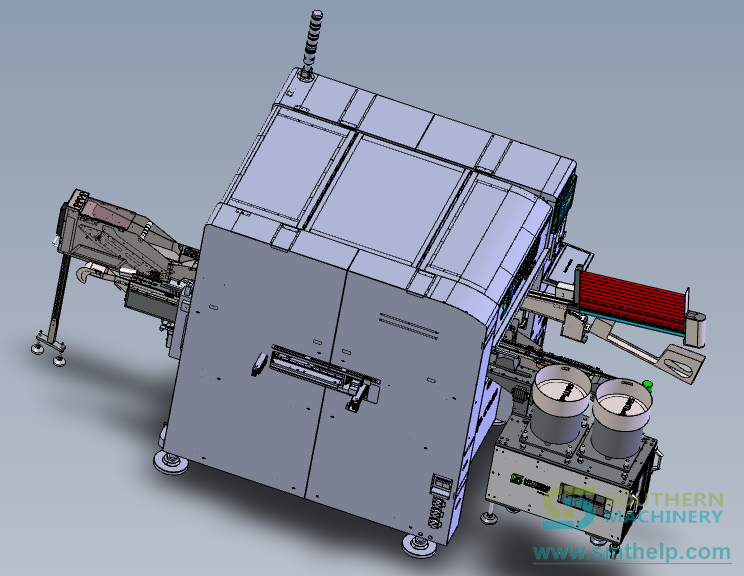
S7900 OddForm Insertion Machine Solution for Smart EMS THT PCB Assembly
S7900 odd-form insertion machine: 2, 4 or 6 servo heads, 0.6-0.8 s per component, 0.6-2.0 mm board, 0-360 degree insertion, four lead-clinching patterns and bowl, tape, tube and tray feeders on one platform. Includes a 36-line THT BOM split and a three-document disclosure table.

S4000 Axial Insertion Machine
S4000 axial inserter: 20,000 CPH published top speed, 5-60 modular feeder stations, any-angle insertion on a servo rotary table, dual jumper-wire feeders, 0.79-2.36 mm PCB, 50 x 50 to 400 x 300 mm boards. Servo-driven, EtherCAT, MES-ready.

S-300B Radial Lead Molding and Taping Machine
S-300B radial lead molding and taping machine: forms the lead pitch, tests polarity and value, then tapes 180 plus or minus 20 components a minute, boxed or reeled.
Request a quote for SBF1001 Vibratory Bowl Feeder
Send your board, component list or machine model and we reply with a configuration and quotation. Prices are quoted per project.