
AI-Radial-Spleißband 3/5/6 Loch & Spleißschneider
AI-Radial-Spleißband, das den Bestückautomaten beim Rollenwechsel am Laufen hält
AI-Radial-Spleißband ist ein vorgeschnittener Klebespleiß, der zwei Stücke gegurteter Radialbauteile (Kondensatoren, Induktivitäten, LEDs und ähnliche Teile auf Papierträger) verbindet, damit ein radialer Bestückautomat weiter zuführt, wenn eine Rolle oder Ammo-Box leer ist. Jeder Spleiß ist mit Löchern gestanzt, die mit den Transportlöchern des Gurtes fluchten, sodass das Transportrad des Feeders direkt durch die Verbindung läuft. Southern Machinery liefert ihn im 3-Loch- und 5-Loch-Format, aus Krepp- oder Kraftpapier, mit einem Hand-Spleißschneider für Radialgurt mit 12,7 mm und 15,0 mm.
Verbinden Sie das Ende einer Rolle gegurteter Radialbauteile in weniger als einer Minute am Feeder mit dem Anfang der nächsten – ohne die Linie anzuhalten. 3-Loch- und 5-Loch-Spleiße aus Krepp- oder Kraftpapier, beidseitig gestanzt, dazu ein Hand-Spleißschneider für Radialgurt mit 12,7 mm und 15,0 mm.
Wichtigste Merkmale
Neu einfädeln kostet jedes Mal Minuten
Ohne Spleiß hält der Bediener die Station an, fädelt den neuen Gurt durch den Feeder und positioniert ihn auf das erste Bauteil. Multiplizieren Sie das mit jeder Rolle an jedem Feeder in jeder Schicht.
Büroklebeband übersteht das Transportrad nicht
Normales Klebeband verdeckt die Transportlöcher, und der Transportstift hat nichts zum Antreiben. Die Verbindung rutscht, reißt oder klemmt – genau dort, wo niemand hinsieht.
Eine verrutschte Verbindung bedeutet ein Bauteil im falschen Raster
Verschiebt der Spleiß das Raster auch nur um einen Bruchteil eines Lochs, kommen die nächsten Bauteile außermittig am Schneidwerk und am Bestückkopf an. Das zeigt sich als verbogene Anschlüsse und fehlende Bauteile.
Klebstoffreste landen in der Maschine
Minderwertiger Klebstoff quillt aus der Verbindung, nimmt Staub auf und überzieht Führungen und Transporträder. Dann erzeugt das Verbrauchsmaterial Wartungsarbeit.
Ausgefranste Schnitte machen jeden Spleiß zum Glücksspiel
Wird der Gurt mit der Schere geschnitten, liegt das Ende irgendwo zwischen zwei Löchern. Der Spleiß kann sich nicht an Löchern ausrichten, die nicht da sind.
Spontan gekauftes Verbrauchsmaterial geht nachts aus
Spleißband ist günstig, also plant es niemand. Dann findet die Nachtschicht eine leere Schachtel und greift zu irgendeinem Klebeband aus der Schublade.
Spezifikationen
Werte wie in den Unterlagen von Southern Machinery veröffentlicht. Widersprechen sich zwei Quellen, werden beide Werte mit Quelle gezeigt.
| Application | Splicing taped radial (vertical-insertion) components on auto-insertion machines and radial tape feeders · Verified material |
|---|---|
| Standard formats | 3-hole and 5-hole · Verified material |
| Other formats | 6-hole, 2-hole, single-hole, black 3-hole: on request · To be confirmed |
| Backing | Masking paper or kraft paper · Verified material |
| Adhesive | High-viscosity, high-strength; synthetic rubber type per factory listing; masking version no residue · Verified material |
| Converting | Precision die-cut on front and back faces, enlarged holes, raised locating dots · Verified material |
| 3-hole splice size | 42 mm long × 36 mm wide (unfolded), one listing; see the open points below · To be confirmed |
| Packing | Masking: 1,000 pcs/roll · Kraft: 500 pcs/roll (Southern Machinery codes) · Verified material |
| Product codes | SCT-031000 · SCT-030500 · SCT-051000 · SCT-050500 · Verified material |
| Splice cutter | Hand tool, versions for 12.7 mm and 15.0 mm radial tape · Verified material |
| Efficiency claim | Splicing without stopping raises process efficiency by about 15% (Southern Machinery product page) · To be confirmed |
| Delivery | Packed by carton; about 2 days after order confirmation · Verified material |
| Tape standard (reference) | Radial taping commonly follows IEC 60286-2: 18 mm carrier, 12.7 mm feed-hole pitch; some larger parts at 15.0 mm · Concept illustration |
Modelle, Vergleiche und offene Punkte
Which splice for which job (4 Zeilen)
| Situation | Start with | Why |
|---|---|---|
| Small radial parts: ceramic, film, small electrolytic capacitors, LEDs | 3-hole, masking paper | Short joint, clean release, highest splices per roll. |
| Heavier parts: larger electrolytics, inductors, long tape paths | 5-hole | More feed holes bridged means more adhesive area carrying the load. |
| Tape guides that drag, or a feeder that prefers a smooth face | Kraft paper | Coated, smooth surface slides with less friction. |
| Unusual hole pattern or longer splice | 6-hole or made to order | Send a tape sample; we confirm the pattern first. |
Where the source documents disagree, both values stay on the page (4 Zeilen)
| Topic | Source A | Source B | How we settle it |
|---|---|---|---|
| Packing per roll | Southern Machinery page: masking 1,000/roll, kraft 500/roll | Factory listings: both backings offered at 500 and 1,000/roll | Quoted per your order; the roll count is written on the quotation. |
| 3-hole splice width | Factory listing: 42 × 36 mm | Another listing: 42 × 22 mm with 12.7 mm hole pitch (double-sided variant) | We send the drawing for the exact splice before you order. |
| Hole counts | Southern Machinery codes: 3-hole and 5-hole | Factory listings: also 6-hole, 2-hole, single-hole | 3 and 5 are stock; others are confirmed per request. |
| Cutter size meaning | Product page: 'for 12.7 mm & 15.0 mm tape' | Photos mark the blades 12.7 mm and 15.0 mm | We match the cutter to the feed-hole pitch on your tape drawing. |
Im Detail
What AI radial splicing tape is
AI radial splicing tape is a pre-cut, adhesive splice that joins two pieces of taped radial components (capacitors, inductors, LEDs and similar parts on a paper carrier) so a radial auto-insertion machine keeps feeding when one reel or ammo box runs out. Each splice is punched with holes that line up with the tape's feed holes, so the feeder's sprocket advances straight through the joint. Southern Machinery supplies it in 3-hole and 5-hole formats, in masking paper or kraft paper, with a hand…
A radial inserter never stops because of a hard part. It stops because a reel ran out.
Every radial line has the same weak moment: the last component on the tape. If the next reel is joined by hand with office tape, or not joined at all, the machine waits while someone re-threads the feeder. A proper splice turns that stop into a 40-second job done while the machine keeps working.
- Re-threading costs minutes, every time. Without a splice the operator stops the station, threads the new tape through the feeder and indexes it to the first component. Multiply that by every reel on every feeder, every shift.
- Office tape does not survive the sprocket. Generic tape covers the feed holes, so the sprocket pin has nothing to drive. The joint slips, tears or jams at exactly the point where nobody is watching.
- A slipped joint means a mis-pitched part. If the splice shifts the pitch by even part of a hole, the next components arrive off-centre at the cutter and insertion head. That shows up as bent leads and missing parts.
- Adhesive left behind ends up in the machine. Low-grade glue oozes from the joint, picks up dust and coats guides and sprockets. Now the consumable is creating maintenance work.
- Ragged cuts make every splice a guess. Cutting tape with scissors leaves the end anywhere between two holes. The splice cannot register on holes that are not there.
- Consumables bought ad hoc run out at night. Splice tape is cheap, so nobody plans it. Then the night shift finds an empty box and reaches for whatever tape is in the drawer.
Four moves at the feeder, no tools beyond the cutter
The method below is the one printed on the source sheets for this tape. It is the same for 3-hole and 5-hole splices; the longer splice simply bridges more feed holes.
- Cut on the feed hole. Cut both tape ends through the centre of a feed hole, square to the tape. The splice cutter does this in one press, at the right pitch.
- Peel the liner. Lift the backing paper off the splice. The die-cut liner means your fingers never touch the adhesive face.
- Seat the locating dots. Press the raised locating dots on the splice into the feed holes of both tape ends, so the two ends sit at the original pitch, then press down.
- Fold and press. Fold the splice along its centre line over the other face of the tape and press. The joint is now closed on both faces and ready to feed.
What is in the splice, what it changes, and what you get
Six things the tape and cutter do, written the way your process engineer and your purchasing manager will each want to read them.
- High-tack adhesive.
- Die-cut both faces.
- Locating dots.
- Two backings.
- No-touch liner.
- Splice cutter.
Choose by hole count, backing and tape pitch
Four standard splice codes cover most radial lines. Other hole counts and a black version are made to order.
- SCT-031000. The everyday splice for small radial parts. Clean release, no residue.
- SCT-030500. Coated kraft face for low friction through tape guides.
- SCT-051000. Longer bridge across five feed holes for heavier parts and long tape paths.
- SCT-050500. Five-hole strength with the smooth kraft surface.
- Radial tape splice cutter. Prepares a square cut on the feed hole so the splice registers first time.
- Made to order. Tell us the hole pattern and backing you need; we confirm the drawing before production.
- Which splice for which job.
Where the source documents disagree, both values stay on the page
We do not average conflicting numbers or quietly pick one. Here is each disagreement and how we settle it for your order.
Five steps from a tape photo to a running splice
A photo or sample, the tape width and feed-hole pitch, the component and the machine model.
Videos
Clips aus dem YouTube-Kanal von Southern Machinery. Von YouTube wird erst etwas geladen, wenn Sie auf Abspielen drücken.
Kataloge und Dokumente
- PDFSplice Tape and Splice toolsSplice tape and splice tools
- PDFSMT Splicing cart and Splicing toolsSMT splicing cart and splicing tools
- PDFC24639000 HAND SPLICING TOOL 3DHand splicing tool C24639000, 3D drawing
- PDFAI SMT spare parts - 2020AI and SMT spare parts 2020
- PDFS3000 Radial Insertion machine 2024S3000 radial insertion machine 2024
- PDFS3010A Radial InserterS3010A radial inserter
- PDFCarrier Clips for UIC Radial Insertion Machine 2018Carrier clips for UIC radial insertion machines
- PDFS-300B Fully Automatic High-Speed Molding and Taping MachineS-300B molding and taping machine
- PDFRadial Feeder User ManualRadial feeder user manual
- PDFSMThelp Auto Insertion PCB assembly requirementsAuto insertion PCB assembly requirements
- 3D↗ file.autoinsertion.comYouTube video board
- 3D↗ file.autoinsertion.comProduct catalog board
- 3DS3000 radial insertion machine
- 3DS-300B radial molding and taping machine
- 3DS4000 axial insertion machine
- 3DS3010A radial auto insertion
- LINKMachine catalog: file.autoinsertion.com
Technische Notizen
01 · 3 min readThe cheapest part on your radial line is the one that stops itA splice costs less than the component next to it. The stop it prevents costs more than the shift's coffee budget.Read the article
Article text is kept in English on every language version: these are technical pieces and a machine translation would blur the details. Ask a production manager what stops a radial line and you will hear about bent leads, a worn cutter, a board that warped in the oven. Now look at the downtime log. The most common…
Look at what actually stopped the line
Ask a production manager what stops a radial line and you will hear about bent leads, a worn cutter, a board that warped in the oven. Now look at the downtime log. The most common entry is not a failure at all. It is "reel change." A feeder ran empty, and the machine waited. A reel change is not dramatic, so nobody…
02 · 3 min readThree holes or five: the splice choice most engineers make by habitHole count is a load decision, not a preference. Here is how to decide it in one minute.Read the article
Article text is kept in English on every language version: these are technical pieces and a machine translation would blur the details. Walk around a dozen factories and ask why they use the splice they use. The honest answer is usually: that is what the last buyer ordered. Habit is fine until a heavy part starts…
Nobody chose 3-hole. It was just in the drawer.
Walk around a dozen factories and ask why they use the splice they use. The honest answer is usually: that is what the last buyer ordered. Habit is fine until a heavy part starts pulling joints apart halfway down the feeder. A splice carries load. The feeder pulls the tape forward one pitch at a time; the guides bend…
03 · 3 min readMasking paper or kraft: choose the backing by the machine, not the price listTwo backings, two behaviours in the tape path. Your guides already know which one they prefer.Read the article
Article text is kept in English on every language version: these are technical pieces and a machine translation would blur the details. Most buyers treat masking and kraft as two colours of the same thing. Pick the cheaper one, move on. The tape path does not see it that way. The backing is the surface that slides…
The backing is not decoration
Most buyers treat masking and kraft as two colours of the same thing. Pick the cheaper one, move on. The tape path does not see it that way. The backing is the surface that slides over every guide between the reel and the insertion head. Masking paper carries a high-viscosity masking adhesive that holds firmly and…
Vollständige Artikel auf der interaktiven Produktseite lesen →
Häufige Fragen
Wofür wird AI-Radial-Spleißband verwendet?
Es verbindet das Ende einer Rolle oder Ammo-Box gegurteter Radialbauteile mit dem Anfang der nächsten, sodass ein radialer (vertikaler) Bestückautomat oder ein Radialgurtfeeder weiter zuführt, ohne neu eingefädelt zu werden. Der Spleiß hat Löcher passend zu den Transportlöchern des Gurtes, der Feeder treibt also durch die Verbindung hindurch.
Sollte ich 3-Loch- oder 5-Loch-Spleiße verwenden?
Beginnen Sie mit 3-Loch für kleine, leichte Radialbauteile und kurze Gurtwege. Wechseln Sie zu 5-Loch für schwerere Bauteile wie größere Elektrolytkondensatoren und Induktivitäten oder wenn der Gurt um mehrere Führungen läuft, denn der längere Spleiß überbrückt mehr Transportlöcher und verteilt die Last auf mehr Klebefläche. 6-Loch ist auf Anfrage erhältlich.
Kreppapier oder Kraftpapier: Was ist der Unterschied?
Kreppapier verwendet einen hochviskosen Kreppklebstoff, der gut hält und keine Rückstände hinterlässt. Kraftpapier ist ebenfalls hochviskos, hat aber eine beschichtete, glatte Oberfläche, die mit weniger Reibung durch Gurtführungen gleitet. Im Zweifel testen Sie beide eine Woche lang am selben Feeder.
Für welche Maschinen ist es geeignet?
Für radiale Bestückautomaten, die Radialgurt mit Papierträger verarbeiten, darunter S3000 und S3010A von Southern Machinery, sowie für Radialgurtfeeder an SMT-Bestückern. Da sich Gurtlieferanten unterscheiden, bestätigen wir die Passung vor Ihrer Bestellung anhand eines Fotos oder Musters Ihres Gurtes.
Kann ich es für Axialgurt (horizontal) verwenden?
Nein. Axialgurt ist anders aufgebaut und hat keine Transportlöcher auf einem Papierträger. Fragen Sie uns stattdessen nach dem Spleißband für die horizontale Bestückung.
Was macht der Spleißschneider, und welche Größe brauche ich?
Er schneidet den Radialgurt rechtwinklig durch die Mitte eines Transportlochs, damit der Spleiß im richtigen Raster sitzt. Es gibt Ausführungen für 12,7-mm- und 15,0-mm-Gurt. Die meisten Radialgurte haben ein Transportlochraster von 12,7 mm; manche größeren Bauteile sind mit 15,0 mm gegurtet. Prüfen Sie Ihre Gurtzeichnung oder senden Sie uns ein Foto mit Lineal, und wir sagen es Ihnen.
Wie wird ein Spleiß hergestellt?
Schneiden Sie beide Gurtenden durch die Mitte eines Transportlochs, ziehen Sie die Schutzfolie ab, drücken Sie die Positionierpunkte des Spleißes in die Transportlöcher beider Enden, falten Sie den Spleiß dann entlang seiner Mittellinie über die andere Seite und drücken Sie ihn an. Arbeiten Sie an der Rolle oder am Feedereingang, nie in einer laufenden Maschine.
Wie lange kann ich es lagern?
Rollen verschlossen, vor direkter Sonne und Wärme geschützt lagern. Für das SMD-Spleißband von Southern Machinery lautet die veröffentlichte Empfehlung etwa sechs bis zwölf Monate bei rund 10 bis 30 °C; fragen Sie uns nach der Empfehlung für die gelieferte Charge des AI-Bandes.
Wie sind Verpackung und Lieferzeit?
Die Spleiße kommen auf Rollen (bei unseren Standardcodes 1.000 pro Rolle für Kreppapier und 500 pro Rolle für Kraftpapier), verpackt im Karton. Bestellungen werden in der Regel etwa 2 Tage nach Auftragsbestätigung versandt. Nennen Sie uns Ihren Monatsverbrauch, und wir planen die Menge mit Ihnen.
Wie erhalte ich ein Angebot?
Senden Sie ein Nahfoto Ihres Gurtes, seine Breite und sein Raster, den Bauteiltyp, Ihr Maschinen- oder Feedermodell und ungefähr Ihren monatlichen Spleißverbrauch an info@smthelp.com oder per WhatsApp an +86 136 0256 2576. Wir antworten mit den passenden Codes und einem schriftlichen Angebot.
Ähnliche Produkte

S-300B Radial-Biege- und Gurtmaschine
Radial-Biege- und Gurtmaschine S-300B: formt das Anschlussraster, prüft Polarität und Wert und gurtet dann 180 ± 20 Bauteile pro Minute, in Box oder auf Rolle.

SMT-Feeder-Kalibriervorrichtung – visuelle Prüfung der Feedergenauigkeit für die smarte EMS-Leiterplattenbestückung
Prüfen Sie Aufnahmeposition, Vorschubbewegung und Ausrichtung eines Feeders, bevor er zurück in die SMT-Linie geht. CCD-Kamera, LCD-Monitor, X/Y/H-Justage, FUJI-NXT-Aufnahme. 220 V, 45 kg – alle Werte mit Quellenangabe.
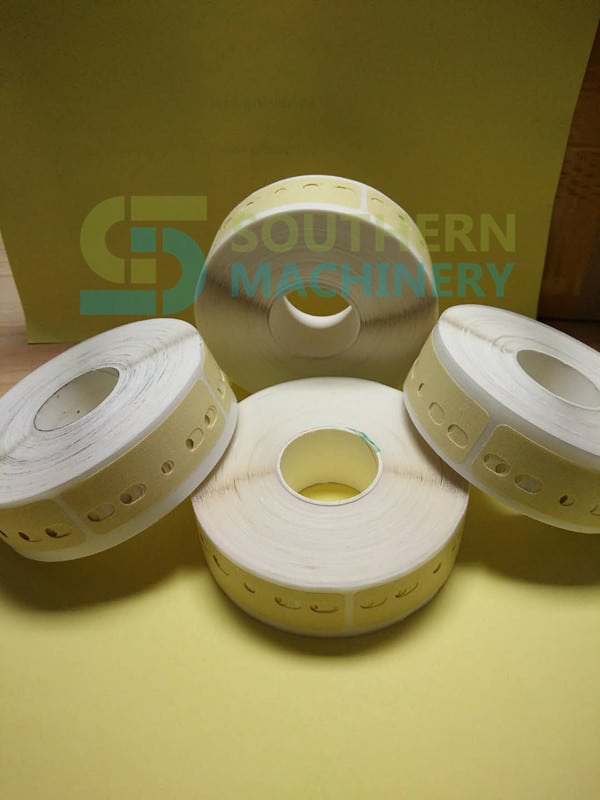
Spleißband für radiale THT-Bauteile (3/5/6 Loch) für die automatische Bestückung
Hochviskoses AI-Spleißband für radial gegurtete THT-Bauteile (Kondensatoren, Induktivitäten, Dioden) auf 12,7-mm- und 15,0-mm-Gurt. Krepp- oder Kraftpapier, gestanzte 3/5/6-Loch-Muster, keine Klebstoffrückstände, +15 % Zuführeffizienz. SCT-Serie von Shenzhen Southern Machinery.
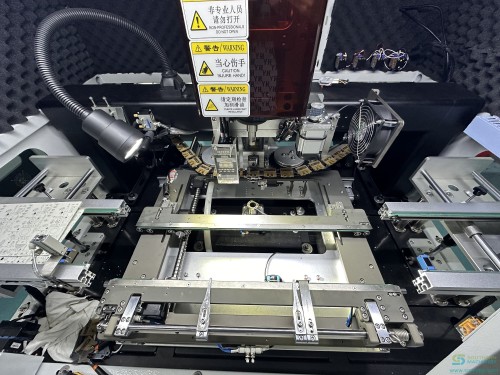
Radialbestückautomat S3000 für die smarte EMS-THT-Leiterplattenbestückung
Radialbestückautomat S3000 für die THT-Leiterplattenbestückung: gegurtete Radialbauteile mit bis zu 20.000 CPH, Bestückwinkel 0–360 Grad, 10 Feederstationen und Lochkorrektur per Bildverarbeitung.

Axialbestückautomat S4000 für die smarte EMS-THT-Leiterplattenbestückung
Axialbestücker S4000: veröffentlichte Höchstgeschwindigkeit 20.000 CPH, 5–60 modulare Feederstationen, Bestückung in jedem Winkel auf einem Servo-Drehtisch, doppelte Drahtbrücken-Feeder, Platinendicke 0,79–2,36 mm, Platinen 50 x 50 bis 400 x 300 mm. Servoangetrieben, EtherCAT, MES-fähig.
Einige technische Angaben auf dieser Seite (Tabellen, Dokumenttitel) erscheinen wie veröffentlicht auf Englisch.
Angebot anfordern: AI-Radial-Spleißband 3/5/6 Loch & Spleißschneider
Senden Sie Ihre Platine, Bauteilliste oder Ihr Maschinenmodell, und wir antworten mit einer Konfiguration und einem Angebot. Preise werden projektbezogen kalkuliert.